About Empyrean Defense Research
Empyrean Defense Research produces unclassified, physics-backed analysis of real wargaming scenarios across every domain in Joint All-Domain Operations (JADO). Our intent is to be useful - from Congressional staffers evaluating program funding to the depot technician maintaining the effector - not to propagandize results. As Americans, we may not always like the findings. Physics doesn't care.
The Empyrean Defense Wargaming & Simulation Cyber Range began as an organic training module inside our platform - the Decision Dominance Engine (DDE) - and grew into a high-fidelity simulation engine that models sea states, RF propagation, CEC uplinks, beamforming, blast pressure, thermoclines, atmospheric extinction, and more across dozens of public-domain, widely-accepted physics formulas. We cannot account for every variable in a live engagement, and we err on the side of optimism from detection through battle damage assessment. Where we approximate, we say so.
Every entity in our scenarios - what we call a "playing card" - is built from open-source, public-domain data; aggregated from U.S. and allied defense publications, academic research, OSINT blogs, manufacturer specifications, and social media. We do not claim these numbers will survive the rigors of a real fight. We do not claim to know the exact RCS nor fuze proximity parameter, or anything else other than the manufacturers and maintainers would know.
We do claim the math is honest, the methodology is transparent, and every simulation run is reproducible from the scenario file and seed alone. In the interest of protecting our core IP, we cannot make that available, as it runs against a live engine.
Foreword
When studying these more kinetic scenarios, these artifacts have been harder to write than the last, and not because the physics got more complicated.
In Quantifying Layered Naval Defense Against Hypersonic Glide Vehicles we asked ourselves whether an Arleigh-Burke destroyer could survive a DF-17 hypersonic glide vehicle salvo. The ship died in every run. Every variant, evasion level, every time. The finding was clinical: the engagement timeline is geometry, not engineering, and you cannot defeat geometry with a better missile. The human cost column at the end was the part that kept me up at night - 329 souls aboard a ship that cannot defend itself against a weapon that costs less than a used German SUV per life.
This paper asks a different question. Not whether a ship can survive, but whether Marines can hold an island - or at least a strategically consequential part of one.
The progression is deliberate, it's inextricably linked by the INDOPACOM theater, but examining the minute-to-minute life of a smaller unit which is one tiny part of what could be a massive theater if peace is not to prevail. In this paper, we're taking several steps backwards in the PLARF's operational sequence, focusing on what a small sliver of a "Day 0" early or preemptive strike could look like. If the Navy cannot park a Burke off Miyakojima because the DF-21D will kill it, and if the Air Force has been contested out of the immediate operating area, then the Marines are on their own.
As far as organic Integrated Air Defense Systems (IADS), the United States Marine Corps has the Medium Range Intercept Capability (MRIC) - the first medium-range air defense system the Corps has fielded since HAWK retired in the 1990s. The MRIC is a derivative of the Israeli Defense Force (IDF) Iron Dome system, with the SkyHunter interceptor reportedly 90-95% parts compatible with the Tamir. Rounding out the MRIC battery is the AN/TPS-80 Ground/Air Task-Oriented Radar (G/ATOR). Then there is the Marine Air Defense Integrated System (MADIS) which uses JLTV and MRZR mounted radars, EW suites, FIM-92 Stinger launchers, 30mm autocannons, and other GPMGs to provide cooperative, layered Counter-UAS and Short Range Air Defense (SHORAD).
The question is whether these organic systems with their ready rounds are enough to survive the opening act of a PLARF sequential exhaustion campaign. The answer is: almost. And "almost" is the cruelest word in this business of war, and why I largely loathe publishing these.
As you'll find out in our scenario setup, the MRIC battery performs brilliantly. 92.7% kill rate with 1.44 rounds per kill. While we do not know how Cooperative Engagement Capability (CEC) with Common Aviation Command and Control System (CAC2S) will work, we used it for salvo discipline of "shoot-look-shoot" network wide, which distributes targets efficiently across four Transport, Erector, Launchers (TELs) with zero dogpiling. The SkyHunter defeats sea-skimming CJ-10s at 50-meter altitude against 2G terminal weave with consistent two-hit kills. The system does exactly what it was designed to do.
And then the magazine runs out. More cruise missiles arrive, smaller in number as the PLARF batteries opposite of the Strait have a few ready-reserves left. Small, but enough for their mission to prevent Strait-blocking operations on Miyakojima and denying the usage of the airport on the western part of the island.
I agonized about this paper the same way I agonized about theoretical Arleigh-Burkes carrying PAC3-MSE/AEGIS to defend against hypersonic threats. The MRIC is a good system and no doubt the Marines operating it are doing everything right. The finding is not that the equipment fails - it is that 80 rounds is not enough depth to survive the PLARF's doctrine of sequential exhaustion, 80 rounds represents 4 launchers which is an entire MRIC battery, and based on public domain data, exactly one-third of the fully deployable systems. The PLARF 623rd Brigade - operators of the CJ-10/CJ-10A - has six launch battalions. We tested two battalions plus a reserve battery.
During development of this Research Artifact, we discovered and fixed a fundamental oversimplification in our proportional navigation guidance implementation. The original code was blending pursuit curves - the interceptor chasing the target - with lead-pursuit intercepts. We rebuilt the guidance pipeline into a three-phase architecture: boost, augmented proportional navigation midcourse, and adaptive terminal. The fix made the simulation more accurate. It also made the results worse, not better. Longer fly-out times led to wider miss distances led to more rounds per kill.
We re-ran the previous hypersonic research scenarios and the findings converged towards a worse outcome, not that there is much worse than losing an Arleigh-Burke and 329 souls, but across all simulated interceptors the average posthumous intercept rate decreased. We will not be updating that Research Artifact, the geometry remains unsolvable.
The Marine Corps, our beloved Devil Dogs, need more MRICs and more Skyhunters. They need service-organic BMD, more organic EW, and more ammo: because those boys need to come home.
- Empyrean 7
Abstract
Across 50 Monte Carlo seeds, a USMC organic IADS deployment - 4 MRIC TELs (80 SkyHunter interceptors), 2 AN/TPS-80 G/ATOR radars, 2 MADIS Mk1 (Stinger + 30mm), and 2 MADIS Mk2 (RPS-42 radar + Modi II EW) - defended Shimoji-shima Airfield on Miyakojima against PLARF CJ-10 land-attack cruise missile salvos in a two-wave engagement. CEC via CAC2S provided network-wide fire control with our "CEC-SALVO" network-wide Shoot-Look-Shoot discipline preventing launcher dogpiling.
Wave 1 (48 CJ-10s at 45-75 m AGL): The MRIC layer destroyed all 48 inbound missiles with zero leakers. All 80 SkyHunter rounds were expended - the battery went Winchester in 100% of seeds. Mean engagement efficiency was 1.44 SkyHunters per CJ-10 kill. CEC-SALVO distributed targets across four TELs with no redundant engagements.
Wave 2 (12 CJ-10s at T+15 min launch delay, arriving T+28 min): With the MRIC Winchester, the defense transitioned to MADIS Stinger and 30mm autocannon - SHORAD systems intended for counter-UAS, not anti-LACM. MADIS Mk1 damaged but could not kill inbound CJ-10s fast enough. The remaining CJ-10s systematically destroyed every defended asset: MADIS vehicles, G/ATOR radars, empty MRIC TELs, and the airfield. Total annihilation arrived at T+28:37, the airfield and all modeled equipment was destroyed in 50 of 50 simulations across different seeds.
We have seven key findings from this data:
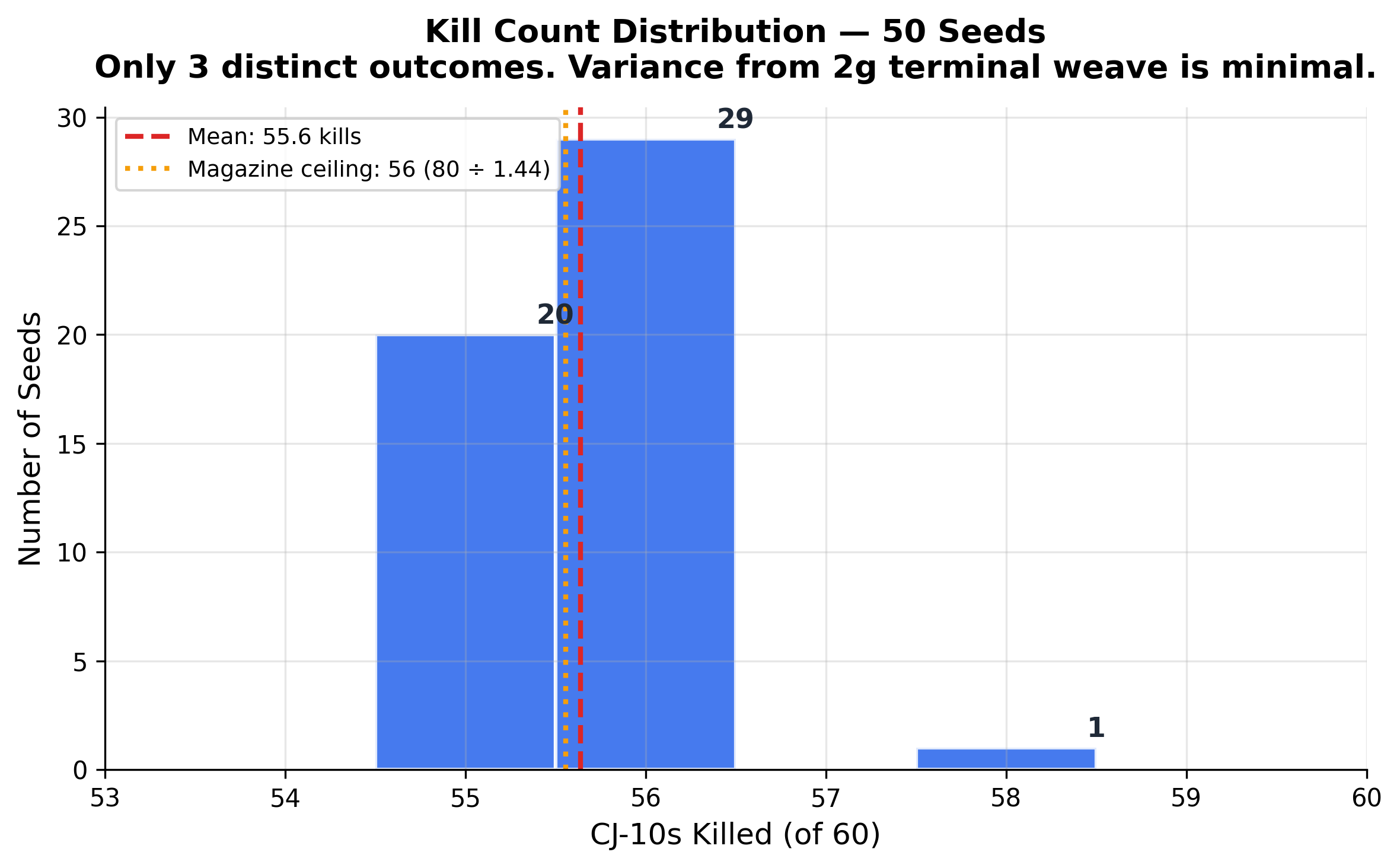
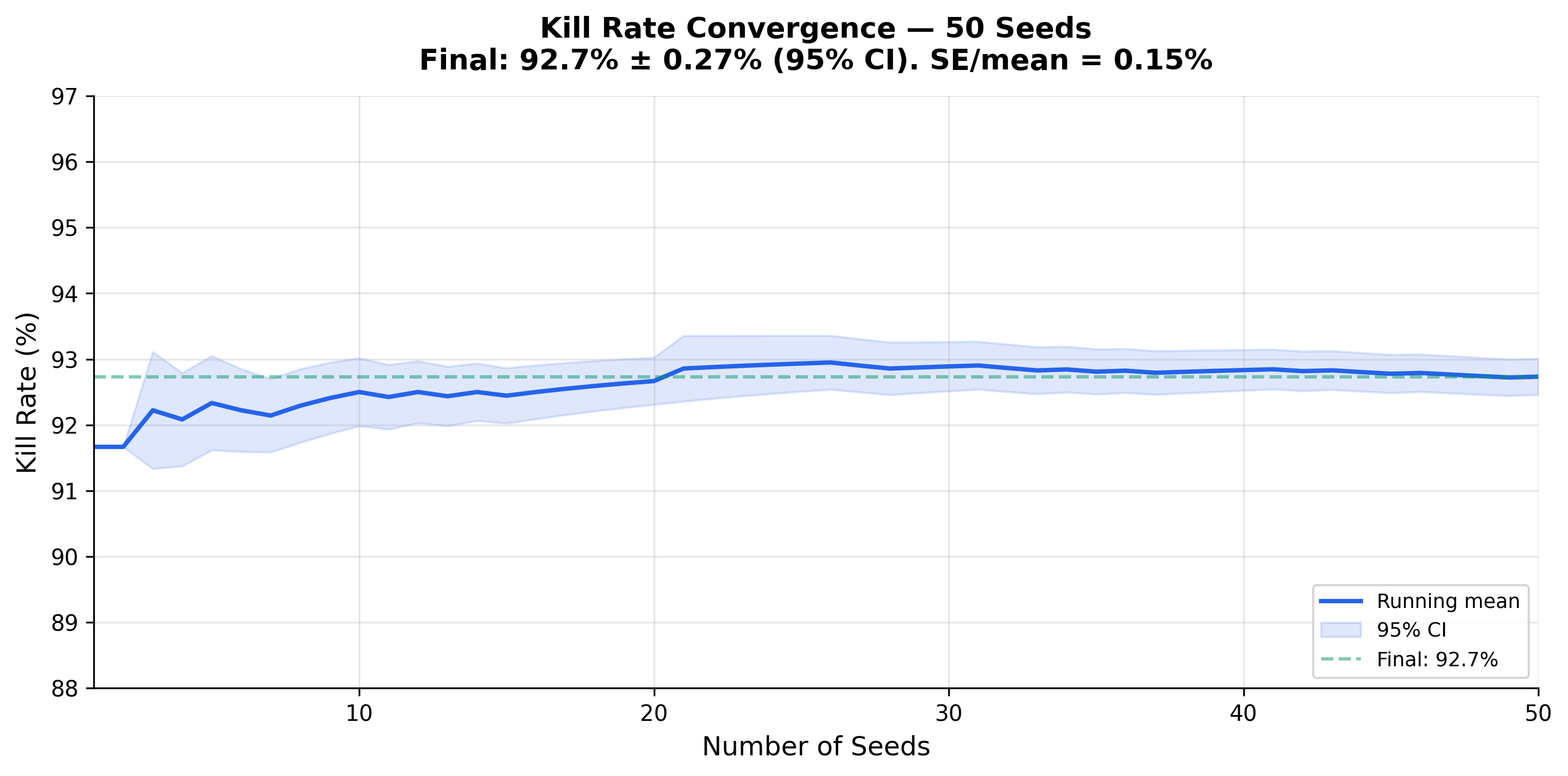
1. Kill rate: 92.7% ± 1.0% (55.6 of 60 CJ-10s destroyed). Converged by seed 10 with a standard error 0.15% of mean. Kill distribution: 55 kills (40% of seeds), 56 kills (58%), 58 kills (2%).
2. Magazine exhaustion is the failure mode, not interceptor performance. At 1.44 rounds per kill, the 80-round magazine services approximately 55, but never more than 58 of the 60 CJ-10s. The 4-5 leakers are the arithmetic consequence of a ready-magazine deficit, not fire control failure, as far as we can simulate.
3. Networked salvo discipline works. Network-wide in-flight weapon tracking prevented launcher dogpiling across all 50 seeds. TELs distributed targets efficiently with shoot-look-shoot discipline against subsonic threats with zero redundant engagements observed. This is based on a total guess on how CEC networked GBAD would work, real-life performance may be even better.
4. MADIS provides last-ditch defense but cannot hold. Stinger missiles and 30mm autocannons damaged CJ-10 airframes but could not achieve kills fast enough against Mach 0.75 targets. In our progenitor, manually-ran seed in the UX, the 30mm XM914E1 autocannon achieved gun kills on CJ-10 #56 and CJ-10 #59. In that scenario, MADIS Mk. I #1 fought alone for approximately 14 seconds as the sole remaining defender before being destroyed by CJ-10 #37.
5. The double-tap achieves total annihilation. Twelve CJ-10s arriving after the MRIC is Winchester destroyed every asset on the island. The PLARF's 12-round reserve battery - held back specifically for this moment - needed only 8 rounds to kill everything. They sent 12. The reserve battery commander made the right call.
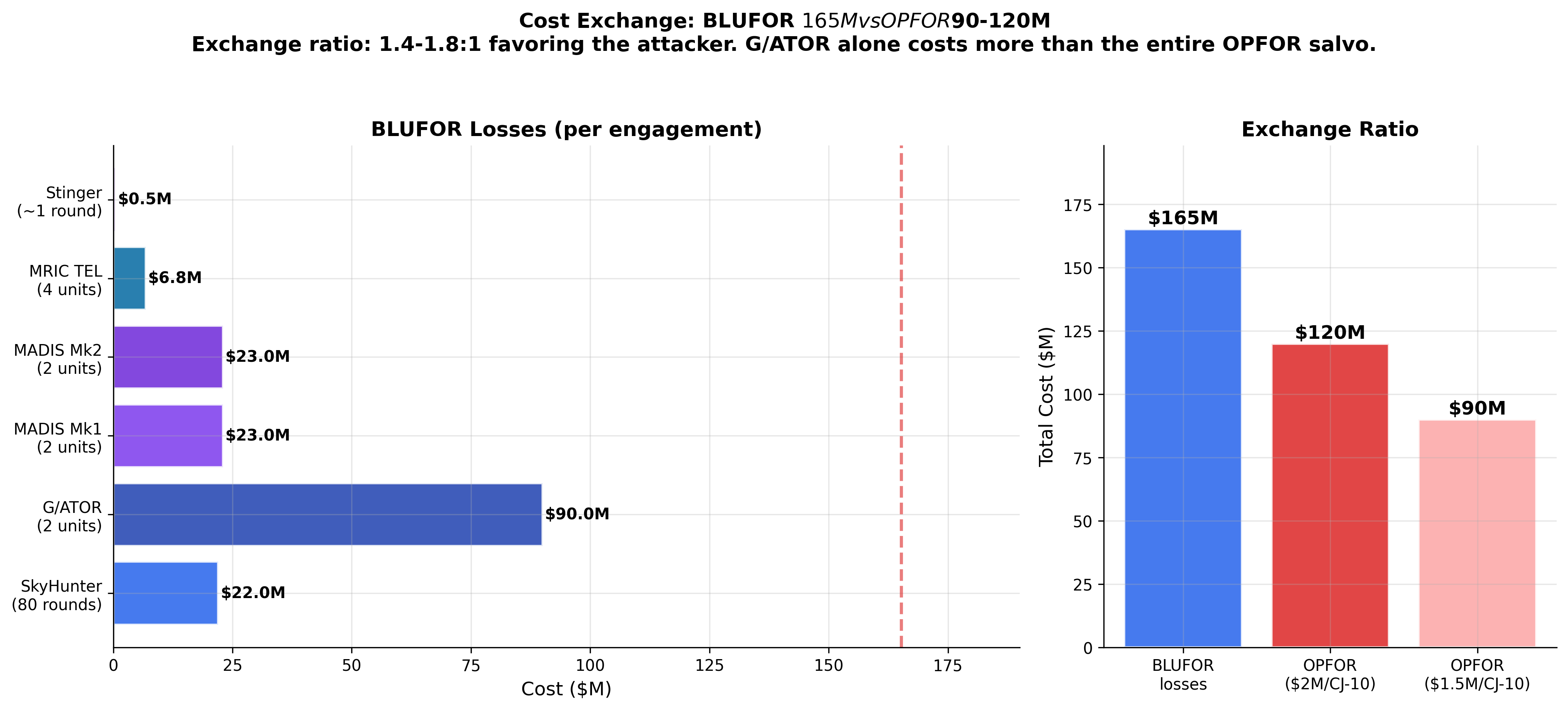
6. Cost exchange favors the attacker: 1.4-1.8:1. BLUFOR modeled equipment and munition losses total $165.3M, excluding runway repair, fuel, aircraft, personnel, contractor losses, strategic disruption, and political cost. OPFOR expenditure is $90-120M (60 CJ-10s at $1.5-2.0M each). Even at a 92.7% kill rate, the defense pays more than the offense. The two G/ATORs alone ($90M) cost more than the estimated OPFOR expenditure.
7. The tested scenario is a fraction of available PLARF capacity. The 623rd Brigade can launch 108+ CJ-10s in the first salvo. We tested 60. The defense collapses at 60. The full brigade has not yet fired.
These results represent upper-bound performance estimates. Every modeling assumption favors the defender. The MRIC is not the failure point. SkyHunter is not the failure point. CEC-SALVO is not the failure point. Magazine depth is the failure point.
Data Provenance & Limitations
All entity parameters are derived from open-source intelligence: CSIS Missile Threat Project, MDAA, The War Zone, Breaking Defense, Northrop Grumman published specifications, Air University CASI PLARF organizational studies, Grey Dynamics ORBAT, and peer-reviewed academic publications on warhead lethality, blast mechanics, and missile aerodynamics. Source URLs are catalogued per entity card in the Empyrean Defense Platform repository. No classified or restricted data was used at any point in this research.
Physics Models
The simulation resolves engagements through a deterministic physics pipeline implemented in the Empyrean Defense Decision Dominance Engine Wargaming & Simulation Cyber Range, we use an internal software package to automate running large-scale simulations, but the product capabilities are the same (just done via the UI). Same seeds produce identical results. This section documents the models relevant to this scenario.
Guidance. Three-phase guided fly-out: analytical Tsiolkovsky boost (3.0s at 180 m/s², propellant mass fraction 0.3), augmented proportional navigation midcourse (N=3.5 with gravity cancellation and FCS energy-budget loft), and adaptive terminal (N=3→5 ramping from t_go=10s to t_go=3s with seeker FOV gating). This three-phase architecture replaced an earlier simplified implementation that blended pursuit curves with lead-pursuit intercepts - the fix increased fly-out times and miss distances but produced physically correct engagement geometry. Vector drag model with Mach-dependent drag polar lookup applied as opposing force vector, not speed scalar.
Warhead damage. Six-mechanism pipeline: Kingery-Bulmash blast overpressure (Hopkinson-Cranz scaled distance), Gurney fragmentation velocity with spatial density distribution, fuze gate adjudication (simulated proximity fuzing, 15m detection range × 2.0 burst window = 30m adjudication window), per-subsystem damage accumulation across typed subsystems (structure, propulsion, guidance, payload), confined blast enhancement for pre-perforated targets, and structural integrity depletion check.
Evasion. CJ-10A terminal weave: 2G (20 m/s²) sinusoidal pattern activating below 500m altitude. Displaces the missile laterally by ~6m per second at cruise speed (255 m/s), spreading interceptor miss distances from the deterministic ~19m to a range of 15-25m across seeds.
Sensors. G/ATOR surrogate modeled as an S-band AESA: 120 km detection against 1.0 m² reference, fourth-root RCS scaling to ~80 km against CJ-10 (0.2 m²), 2.5s update interval, 30m position accuracy. RPS-42 surrogate (Ku-band, MADIS Mk2): 30 km detection, 2.0s update interval, 15m accuracy. CEC track quality model: multi-sensor fusion improves accuracy; degraded single-sensor track adds Gaussian perturbation.
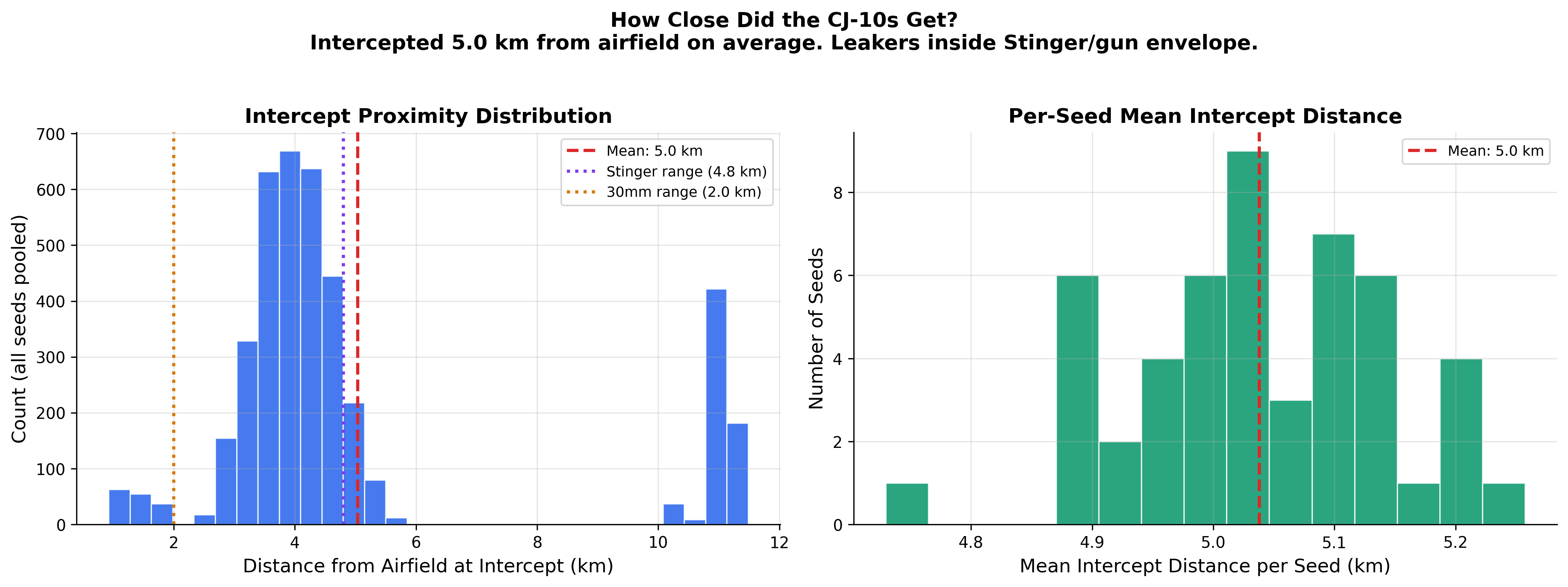
Gun engagement. 30mm XM914E1: STANAG 4355 ballistic trajectory with G7 Mach-dependent drag polar. 350g HEDP round, 800 m/s muzzle velocity, 200 RPM, 15-round burst. 2D Gaussian dispersion at 3.0 mrad. At 2000m against Mach 0.75 CJ-10 at 50m AGL, ~2.5 seconds engagement time per crossing. Average system burst Pk: 0.16-0.36 depending on geometry.
Electronic warfare. Modi II GPS/BeiDou spoofing: ~200W total system power spread across UHF/VHF/ISM/GNSS bands. Link budget analysis shows the Modi II cannot deny military BeiDou with CRPA - effective J/S at 10 km is 16.6-26.6 dB against a required 50-60 dB for military GNSS denial. Even at the modeled 2 km denial range, the CJ-10 spends only ~8 seconds in the bubble with Digital Scene Matching Area Correlator (DSMAC) already active. The Modi II's EW contribution against LACMs is zero in this scenario. Its value is in the C-UAS mission (Group 1/2 SUAS denial at 2-5 km), not anti-LACM EW. This is a publicly stated limitation of capability, not a modeling error.
Optimistic Bias Framework
Every modeling assumption in this study favors the defender. This is by design - the objective is to establish the upper bound of terminal defense performance, not to predict operational outcomes. The actual number, we fear, is worse.
1. Perfect detection. G/ATOR acquires threats at maximum detection range with zero false tracks. The simulation includes sea-state multipath lobing (Beaufort 4, S-band, two-ray propagation factor F⁴ computed per-tick from sensor height, target altitude, range, frequency, and sea state roughness), but does not model false tracks from multipath-induced vertical bias. Track quality degradation from multipath is reflected in detection probability modulation, not in track accuracy perturbation fed to the SkyHunter midcourse update.
2. No OPFOR SEAD. CJ-10s arrive without dedicated anti-radiation missiles (YJ-91 ARM) or SEAD-configured J-16s. A real attack would include SEAD to kill the G/ATOR before the LACM salvo arrives. Losing the G/ATOR before Wave 1 collapses the MRIC engagement range from 70 km to 30 km (RPS-42 backup) if the RPS-42 can resolve sea-skimming LACMs at all.
3. Single-axis attack. All CJ-10s arrive from approximately the same bearing (west-northwest from coastal Fujian). Multi-axis coordination with H-6K-launched CJ-20s from a different azimuth would split sensor coverage and compress the engagement timeline.
4. No electronic attack. Clean electromagnetic environment. No standoff jamming, no chaff corridors, no decoys. A realistic PLARF strike package includes dedicated EA support.
5. No ballistic follow-on. Phase 2 (DF-21D/DF-26/DF-17) is not modeled. This research tests whether the Marines survive Phase 1 with anything remaining. The answer determines whether Phase 2 even needs to engage Miyakojima or can redirect to higher-value targets.
6. Perfect crew. No decision latency under stress, no degraded watchstanding, no battle damage effects on crew performance. Targets are prosecuted at machine speed.
7. No concurrent threat environment. No One-Way Attack (OWA) drone swarms, no loitering munitions, no SEAD, no cyber operations against CAC2S. The entire IADS capacity is dedicated to the CJ-10 salvo.
8. Favorable environment. Beaufort 4 sea state, moderate maritime haze, 10-18 kt easterly wind. No typhoon conditions, no heavy precipitation degrading radar or seeker performance. This was modeled off of the average almanac conditions in the region outside of storm conditions.
Engagement Tempo Model
The simulation resolves engagement decisions at machine speed, with no modeled human hesitation beyond configured sensor, network, and update-cycle latencies. Real-world CAC2S processing, human-in-the-loop authorization, and communication latency would likely slow the engagement tempo. The modeled results assume fully autonomous, human-out-of-the-loop target prosecution. Against 48 CJ-10s arriving over a 4-5 minute window, any human decision latency reduces the number of engagements the MRIC can prosecute before Winchester.
Known Approximations
These exclusions bound the analysis scope. Each represents a potential avenue for future research:
SkyHunter/Tamir-class interceptors versus sea skimmers. SkyHunter/Tamir-class interceptor aerodynamics, drag behavior, and guidance performance are modeled from unclassified public-domain data, Fleeman-style missile sizing and performance methods, and visual analysis of publicly available Iron Dome/Tamir engagement footage. No classified fire-control parameters, seeker behavior, data link behavior, or proprietary performance data are used or inferred.
The simulation includes a three-phase flyout model with boost, midcourse, and terminal guidance. We tested multiple loft and midcourse-profile variants against sea-skimming LACMs at 50-550 m AGL, including lower-altitude and more direct profiles intended to improve terminal geometry at maximum standoff. Under the modeled Miyakojima Strait environment, these profile changes did not materially reduce miss distance or improve terminal energy at the average detection/engagement range.
We therefore retained the baseline proportional-navigation behavior rather than tuning the guidance model to force a better outcome. This is a deliberate anti-overfitting choice. The result should be read as an unclassified, physics-bounded approximation of a Tamir-class interceptor's plausible performance against a target class it was not originally optimized to defeat, not as a claim about the true classified capability of MRIC, SkyHunter, Tamir, Iron Dome, CAC2S, or any associated fire-control system. Where uncertainty remains, the model is biased toward transparent physical assumptions rather than hidden capability claims.
Multipath modeled, track error not. The simulation computes sea-state multipath lobing via a two-ray propagation factor (F⁴) that modulates detection probability based on sensor height, target altitude, range, radar frequency, and Beaufort sea state. At Beaufort 4 with CJ-10s at 50m AGL, the F⁴ factor produces constructive and destructive interference lobes that affect whether the G/ATOR detects the target on a given scan. What is NOT modeled is the vertical track bias that multipath introduces - the reflected ray creates a "ghost" below the real target that biases the track solution. This inherited error would propagate to the SkyHunter's midcourse update, potentially widening miss distances beyond the 15-19m observed. The multipath effect on detection probability is captured; the effect on track accuracy is not.
No radar altimeter disruption model. The CJ-10's terrain-following flight at 50m AGL likely depends on a radar altimeter, which in turn is likely C-band or Ku-band FMCW. Unlike military GNSS with CRPA, radar altimeters are simple sensors with no anti-jam capability. The Modi II could potentially flood the altimeter band, forcing the CJ-10's flight control computer into a safety climb (50m → 150m+) to avoid controlled flight into terrain. Conversely, altimeter degradation could cause the CJ-10 to prematurely detonate, thinking that it is already at its surface depth. These are largely guesses to the susceptibility and performance of the system, open-source data suggests that the latest modernization efforts in the CJ-10A offer far more Electronic Warfare resistance.
No DF-100 substitution. If the PLARF substitutes DF-100 (Mach 3-4 supersonic LACM) for CJ-10 in Wave 1, the SkyHunter (Mach 2.2) faces a fundamentally different engagement timeline. The DF-100 collapses the engagement window the same way the DF-17 collapsed it for the Burke in our HGV interception research - speed, not maneuver, is likely the binding variable.
Threat Characterization
CJ-10 / DH-10 Land-Attack Cruise Missile
The CJ-10 is the PRC's Tomahawk equivalent. Subsonic, long-range, terrain-following, with a four-layer guidance stack that makes GPS denial functionally irrelevant against hardened military variants. The missile does not need to be exquisite. It needs to be numerous, accurate enough, and survivable enough to drain magazines. It is cheap, it is plentiful, and it is the magazine-draining weapon in the PLARF's sequential exhaustion doctrine.
| Parameter | Value | Source |
|---|---|---|
| Speed | 255 m/s (Mach 0.75) | CSIS, MDAA |
| Range | 2,000 km | MDAA |
| Warhead | 500 kg (350 kg Comp-B fill) | MDAA |
| Guidance | INS + BeiDou + TERCOM + DSMAC | CSIS, assessed |
| Cruise altitude | 10-50m AGL (terrain-following) | OSINT consensus |
| CEP | 5-10m (full stack), ~25m (BeiDou-denied) | OSINT consensus |
| RCS | ~0.2 m² | Assessed (non-stealthy airframe) |
| TEL capacity | 3 rounds per TEL | MDAA |
| Evasion | 2G terminal weave below 500m | Assessed |
| Unit cost | $1.5-2.0M | MDAA, CSIS |
At 50m AGL over water, the CJ-10 presents the hardest engagement geometry for a ground-launched interceptor: the SkyHunter must loft from ground level, acquire a target at or below its launch altitude, and execute a diving terminal intercept at crossing geometry against a sea-clutter background. The four-layer guidance stack means that even successful GPS denial only degrades CEP from ~5m to ~25m - TERCOM and DSMAC provide independent position fixes that do not depend on any satellite navigation system.
PLARF Order of Battle: The 623rd Brigade
The PRC Second Artillery Force (now PLARF: People's Liberation Army Rocket Forces) maintains at least two CJ-10 GLCM brigades. The 623rd Brigade under Base 62 is identified by Grey Dynamics and Air University CASI reports as the first operational DF-10A (CJ-10) brigade. Its garrison is in Liuzhou, Guangxi. The parent Base 62 headquarters is in Kunming, Yunnan.
Brigade structure (CASI): Each conventional missile brigade has up to six launch battalions, each with two launch companies. CASI estimates 36-48 TELs per GLCM brigade. At 3 rounds per TEL, a single brigade can launch 108-144 CJ-10s in the first salvo.
| Echelon | Composition | TELs | Rounds |
|---|---|---|---|
| Company | 3-4 TELs | 3-4 | 9-12 |
| Battalion | 2 companies | 6-8 | 18-24 |
| Brigade (623rd) | 6 battalions | 36-48 | 108-144 |
| Two brigades | Full CJ-10 force | 72-96 | 216-288 |
The MDAA estimate of 200-500 total CJ-10 missiles in the PRC arsenal tracks with two brigades at full strength plus depot stock, maintenance reserves, and training rounds. For this research, the tested 60-missile scenario represents approximately one-half of a single brigade's first-salvo capacity. The defense collapses. The brigade has not committed its other three to four battalions.
Forward deployment assumption: The 623rd Brigade's garrison in Liuzhou is ~2,200 km from Miyakojima - beyond the CJ-10's 2,000 km range. The brigade could forward-deploy TEL batteries to coastal Fujian or Zhejiang, using Base 61's existing road network and pre-surveyed launch positions. From coastal Fujian, Miyakojima is ~400 km - well within range with substantial fuel reserve for terrain-following routing. The forward-deploy route runs northeast from Liuzhou through Guangxi and Fujian to coastal staging areas around Fuzhou and Xiamen, roughly a 1,200 km road move requiring 2-3 days for a TEL convoy.
From coastal Fujian, CJ-10 flight time to Miyakojima at Mach 0.75 is approximately 26 minutes (400 km / 255 m/s). This short flight time enables tight salvo coordination and reduces the defender's warning time compared to a 2,000 km shot from garrison.
PLARF Phasing Doctrine
The PLARF's Day 0 calculus against the First Island Chain is almost certainly phased. This sequencing is consistent with Iranian operational patterns that the PRC has likely studied closely. Our guiding assumptions and overall "theorycraft" to set up this scenario is as follows.
Phase 0 - Pre-conflict positioning. TELs disperse to pre-surveyed launch positions under peacetime cover. CJ-10 batteries move to coastal Fujian. DF-21D/DF-26 batteries stay in depth, waiting for targeting data on carrier strike groups. The TELs move openly on the G72/G76 expressway network - WS-2400 8×8 vehicles in convoy. What ISR does not see is whether the canisters are loaded. The actual ordnance could move separately via civilian flatbeds, container trucks, possibly rail. Mating can happen under camouflage netting in dispersed positions indistinguishable from agricultural structures on satellite imagery.
Phase 1 - LACM saturation (magazine drain). CJ-10s and air-launched CJ-20s (from H-6K standoff) strike First Island Chain airfields, radars, logistics nodes, and C2 facilities. The objective is not to destroy everything - it is to force-drain IADS magazines and crater runways. Every SkyHunter expended against a CJ-10 is one less interceptor available for the ballistic follow-on. Every runway cratered is one less recovery option for allied air. This is the phase modeled in this research.
Phase 2 - Ballistic follow-on (kill phase). Once IADS magazines are depleted and ISR has localized high-value targets (carriers, Aegis destroyers, Patriot batteries), the DF-21D/DF-26/DF-17 salvos launch against strategic assets. This is when the PLARF commits its most capable weapons - when the defender has nothing left to shoot with.
Phase 3 - Sustained suppression. CJ-10 reload salvos continue against fixed infrastructure while ballistic missiles service mobile and naval targets.
The CJ-10 is the magazine-draining weapon, that can still bring devastating effects to even moderately reinforced targets, but has the primary mechanism of draining ready-fire IADS/BMD. The DF-17 is the kill weapon. Using them in reverse order wastes the DF-17's value, and exposes it to intercept in its boost and mid-course phases. This phasing logic directly motivates the scenario design: Wave 1 (48 CJ-10s) tests whether the Marines survive the magazine-draining phase. Wave 2 (12 CJ-10s at T+15 min launch delay, arriving ~T+28 min) tests what happens when the reserve battery double-taps a defense that just expended everything - which is exactly where the PLARF wants the defense to be before Phase 2 ballistic follow-on begins.
Phasing Context for Sister Brigades
The 623rd Brigade's CJ-10 salvo is Phase 1 (magazine drain). The sister brigades under the PLARF's Base 62 execute Phase 2:
624th Brigade (DF-21D, Danzhou, Hainan): The Dong-Feng 21D (CSS-5) is an older missile in service since the early-1990s. It is a road-mobile, medium-range ballistic missile (MRBM) with the "Delta" variant purportedly an anti-ship ballistic missile (ASBM), with a nuclear-capable cousin, the DF-21E. The 624th "Carrier Killers" uses the DF-21D to prosecute any U.S. or coalition naval vessels in the theater. This is why the Burke cannot park off Miyakojima; the 624th is ~1,200 km away with DF-21D range of 1,500+ km.
625th Brigade (DF-26, Jianshui, Yunnan): The Dong-Feng 26 (DF-26) is a road-mobile, intermediate-range ballistic missile (IBRM) with reported ranges of 3,000-5,000 km used for combined anti-surface and ground strike capabilities with conventional and nuclear munitions. The 625th "Guam Express" saves the DF-26s for Guam and other Second Island Chain deep targets.
627th Brigade (DF-17, Puning, Guangdong): As told in our previous research on naval layered IADS/BMD versus hypersonic threats, the Dong-Feng 17 (DF-17) is a road-mobile, MRBM that uses Hypersonic Glide Vehicles (HGVs) for high-value time-sensitive targets - Aegis destroyers, Patriot/THAAD batteries, strategic C2 nodes - identified during Phase 1 ISR.
The CJ-10 salvo is not the main event. It is the opening act designed to exhaust IADS magazines and degrade the defender's ability to stop what comes next.
H-6K / CJ-20 Factor (Stated Limitation)
The PLAAF's H-6K carries 6 CJ-20s (air-launched CJ-10 variant) per sortie. A squadron of 12 H-6Ks launching from Nanchang puts 72 CJ-20s in the air from a completely different axis than ground-launched CJ-10s. This research models ground-launched TEL salvos only. A real Phase 1 attack coordinates both axes - 72 CJ-20s from the northeast simultaneously with 24 CJ-10s from the west is a fundamentally different problem. This is noted as a limitation for future work.
USMC Organic IADS Components
MRIC Battery (Medium-Range Intercept Capability)
The MRIC is the USMC's first medium-range ground-based air defense system since HAWK retirement in the 1990s. The SkyHunter interceptor shares 90-95% commonality with the Israeli Tamir (Iron Dome interceptor) but carries a classified US-specific data link and integration architecture. IOC FY2025. The USMC plans three MRIC batteries total - one per Marine Aircraft Wing (MAW) - with 2,000 SkyHunter missiles across the program.
| Component | Quantity (This Scenario) | Role |
|---|---|---|
| AN/TPS-80 G/ATOR | 2 | S-band AESA, search/track/fire control |
| MRIC TEL | 4 (2 per battery section) | 20 SkyHunter rounds each |
| CAC2S | 1 | C2 backbone, track fusion, CEC |
| Total interceptors | 80 | 4 × 20 ready rounds |
SkyHunter specifications:
| Parameter | Value |
|---|---|
| Speed | Mach 2.2 (~750 m/s) |
| Range | 70 km |
| Ceiling | 10 km |
| Warhead | 11 kg HE blast-frag (5 kg casing, 6 kg PBXN-109) |
| Kill mechanism | Directional fragmentation + laser proximity fuze |
| Terminal guidance | Active radar seeker, fire-and-forget |
| Unit cost | ~$275K per round |
This scenario concentrates a battery-scale MRIC package - 4 TELs and 80 ready SkyHunters - on a single 9.68 km² island. Public reporting indicates the USMC plans only three MRIC batteries, making a battery-scale commitment to one island a major allocation of the Corps' medium-range air-defense capacity. This is the maximum credible defense - the Marines cannot do more without Army support (Patriot, THAAD, Typhon) or Navy support (AEGIS). The finding that this maximum defense fails against a single PLARF brigade's Phase 1 salvo is the central result.
MADIS Section (Marine Air Defense Integrated System)
MADIS is a paired system: Mk1 (kinetic) + Mk2 (sensor/EW). JLTV-mounted, expeditionary, designed for counter-UAS but providing layered backup against LACMs.
| Component | Quantity | Role |
|---|---|---|
| MADIS Mk1 | 2 | 4× Stinger (4.8 km, 3 kg HE-frag) + 30mm XM914E1 (2 km, 200 RPM, HEDP) |
| MADIS Mk2 | 2 | RPS-42 radar (30 km, Ku-band, 360°) + Modi II EW (GPS/BeiDou spoofing) |
The MADIS Mk1's 30mm autocannon is the last-ditch kinetic option against leakers. At 200 RPM with a 2 km effective range, the gun has approximately 2.5 seconds of engagement time as a Mach 0.75 CJ-10 crosses the effective envelope - one 15-round burst. Burst Pk ranges from 0.16 to 0.36 depending on crossing angle and range. This is a system designed to kill Group 1/2 SUAS at close range. Against a 500 kg-warhead cruise missile, it is a desperation weapon.
The MADIS Mk2's Modi II EW suite is effective against commercial GPS-dependent targets (Group 1/2 SUAS at 2-5 km). Against the CJ-10 with military BeiDou and CRPA antenna, the EW contribution is zero - the CRPA provides 40-50 dB antenna null rejection against ground-based jammers, and the CJ-10's four-layer guidance stack (INS + BeiDou + TERCOM + DSMAC) provides redundant position fixes that do not depend on any single navigation source.
CEC via CAC2S
All components are linked via CAC2S, modeled as CEC network mric-cac2s. CEC-SALVO discipline prevents multiple TELs on the same network from independently engaging the same target - network-wide in-flight weapon tracking ensures efficient target distribution.
| Entity | CEC Role | Bandwidth | Latency |
|---|---|---|---|
| G/ATOR | sensor | high | 50ms |
| MADIS Mk2 | sensor | medium | 100ms |
| MRIC TEL | shooter | high | 50ms |
| MADIS Mk1 | shooter | medium | 100ms |
Sensor redundancy: If both G/ATORs are destroyed (SEAD priority targets), the MADIS Mk2's RPS-42 provides degraded backup tracks at 30 km detection range, this is likely possible given the ability to resolve small-RCS SUAS targets. The MRIC TELs lose long-range fire control (70 km → 30 km) but are not blind. This redundancy did not factor into the baseline results - both G/ATORs survived Wave 1 - but represents the designed degradation path for the system.
Scenario Design
Engagement Geometry
Shimoji-shima Airfield apron, Miyakojima (24.8267°N, 125.1447°E). Shimoji-shima is a 9.68 km² island in the Sakishima chain, connected to Irabu-jima by bridge. The airfield is the defended asset - a 3,000m runway capable of supporting C-130 operations, fighter recovery, and ISR staging. The MRIC battery and MADIS section are emplaced around the airfield perimeter.
The PLARF foil is the 623rd Brigade, garrisoned in Liuzhou (24.3856°N, 109.5726°E) under Base 62 (Kunming), forward-deployed to coastal Fujian (~400 km from target). CJ-10s approach from the west-northwest at 45-75 m AGL over the East China Sea.
Environment
| Parameter | Value | Source |
|---|---|---|
| Wind | 10-18 kt easterly (sampled stochastically per tick) | Springer (2018) ECS climatology |
| Gust factor | 1.4 | Standard maritime |
| Sea state | Beaufort 4 | ECS annual mean 1.2-1.7m Hs |
| Humidity | 78% | Subtropical maritime |
| Atmospheric extinction | 0.2/km | Moderate maritime haze |
| Air temp | 24°C | Miyakojima annual mean |
Wind affects SkyHunter trajectory via crosswind perturbation and produces seed-to-seed variance in miss distances. Beaufort 4 sea state drives the multipath propagation factor (F⁴) in the radar detection model - constructive and destructive lobing modulates G/ATOR detection probability against 50m AGL targets at S-band frequencies.
Wave Structure
Wave 1 (T+0): 48× CJ-10 at 45-75 m AGL. Two battalions ripple-fire everything. 4-5 minute time-on-target spread from coordination friction - different TEL positions, slightly different terrain-following routing through the Miyako Strait. The objective is not to "engage the IADS" - it is to overwhelm it in one shot. At the observed 1.44:1 interceptor ratio, 48 CJ-10s requires approximately 69 SkyHunters. The defense has 80. The math is tight but survivable - for Wave 1.
Wave 2 (T+15 min launch delay, arriving ~T+28 min): 12× CJ-10 at 45-75 m AGL. Single battery held in reserve. The TEL crews watched Wave 1 effects on ISR feeds - Yaogan SAR pass, BeiDou-linked BDA drone, or SIGINT showing the G/ATOR went quiet. They know the MRIC is Winchester or close to it. The 12-round follow-up is not meant to overwhelm anything. It is meant to crater what remains of the runway, kill any equipment (radars, aircraft, ammo dumps, etc.) that survived, and destroy whatever Wave 1 missed. Against an IADS that just expended everything, 12 CJ-10s arriving unopposed is execution, not combat.
Stochastic Uncertainty Model
The simulation introduces seed-to-seed variance through three channels: CJ-10 evasion (2G terminal weave with random phase), wind sampling (10-18 kt with 1.4 gust factor per tick), and approach corridor variance (slight positional offsets in CJ-10 start positions). These produce the observed kill distribution spread: 55 kills (40%), 56 kills (58%), 58 kills (2%).
Sweep Matrix
1 scenario configuration × 50 Monte Carlo seeds = 50 runs. The scenario was designed as a single configuration that tells the complete story - the phase transition from kinetic defense to EW-plus-guns happens organically when the magazine runs dry, not through variant manipulation.
Results - Wave 1 (48 CJ-10s)
Engagement Timeline
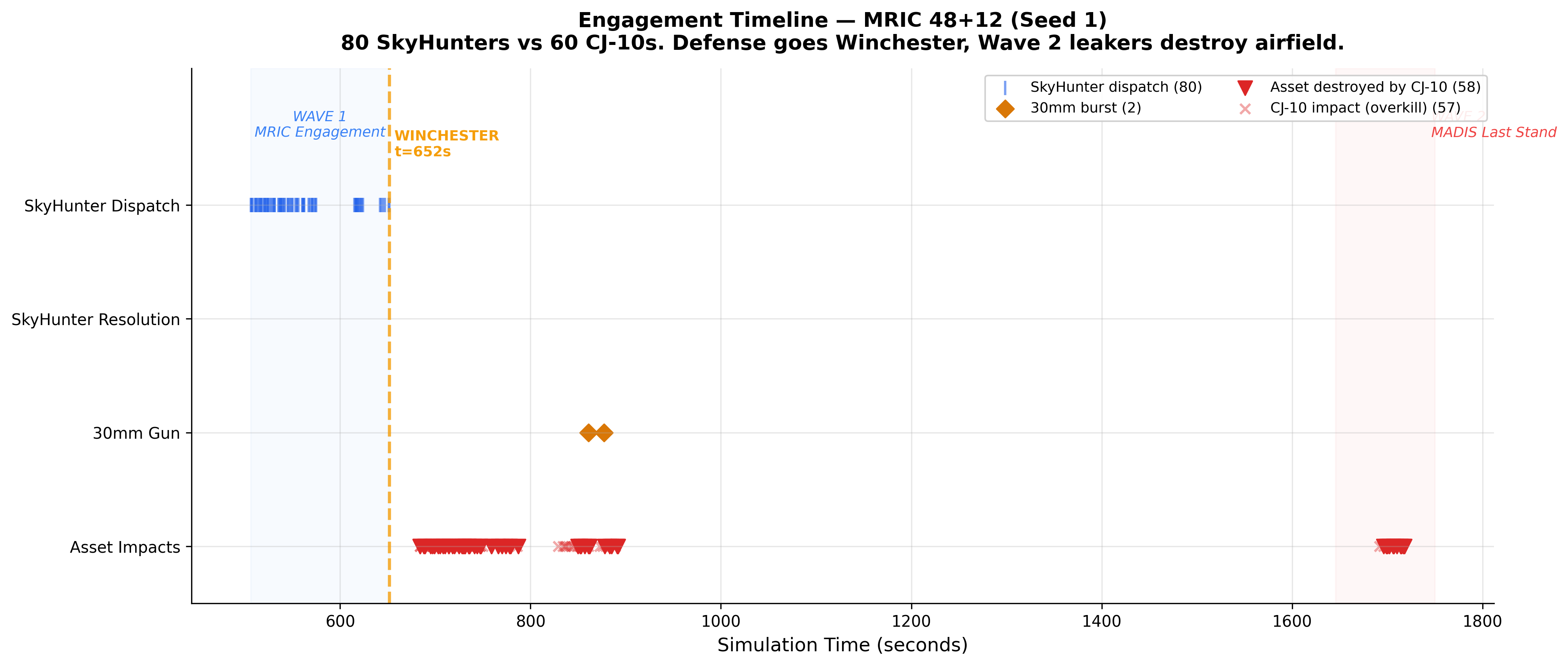
T+00:00    Wave 1: 48× CJ-10 launch from coastal Fujian
           CJ-10s terrain-follow at 45-75 m AGL across Miyako Strait
           Flight time to Shimoji-shima: ~26 minutes

T+08:26    G/ATOR acquires first CJ-10 group at ~80 km
           (120 km reference × (0.2/1.0)^0.25 = 80 km against 0.2 m² RCS)
           Track established, threat classified, CEC-SALVO distributes targets
           First SkyHunters dispatched from all 4 TELs

T+11:24    First kills. SkyHunters resolve at terminal phase.
           Clean 2-hit kills: first SkyHunter damages airframe (~70 HP),
           second SkyHunter destroys it (structure subsystem at 0 HP).
           CJ-10 2g terminal weave spreads miss distances 15-25m,
           producing occasional 3-hit engagements.

T+11:24    CEC-SALVO discipline in effect:
  to       TELs 1-2 service leading CJ-10 group
T+13:07    TELs 3-4 service trailing group
           Shoot-look-shoot: 1 weapon pending per target
           BDA window: 5.0s confirmation latency per resolution
           Zero redundant engagements across 50 seeds

T+13:07    Wave 1 complete. 48/48 CJ-10s destroyed. Zero leakers.
           Approximately 10-12 SkyHunters remain in the converged runs,
           but these are consumed by the Wave 2 vanguard before terminal impact.
Kill Rate and Efficiency
The MRIC layer achieved a 100% kill rate against Wave 1 in the baseline seed and near-100% across all seeds. This is not because the SkyHunter is overpowered - it is because CEC-SALVO discipline distributed 80 rounds efficiently across 48 targets at 1.44 rounds per kill.
SkyHunter engagement physics at 50m AGL: The SkyHunter lofts from ground level, acquires the CJ-10 at terminal via active radar seeker (12° FOV), and executes a diving intercept. Miss distances range from 15-25m depending on CJ-10 terminal weave phase. At 19m miss against the CJ-10's 3.28 m² presented area, the proximity fuze (15m detection range, 30m adjudication window) triggers the 11 kg blast-frag warhead. Fragment density at 19m is approximately 0.15-0.25 fragments/m². Probability of at least one fragment hit: 40-55%. Damage per hit: ~70-80 HP across structure, propulsion, and guidance subsystems. Two hits destroy the CJ-10 airframe (structure subsystem integrity depleted). This drives the observed 1.44 rounds per kill - most engagements require two SkyHunters, occasional engagements at favorable geometry kill in one.
Magazine Consumption
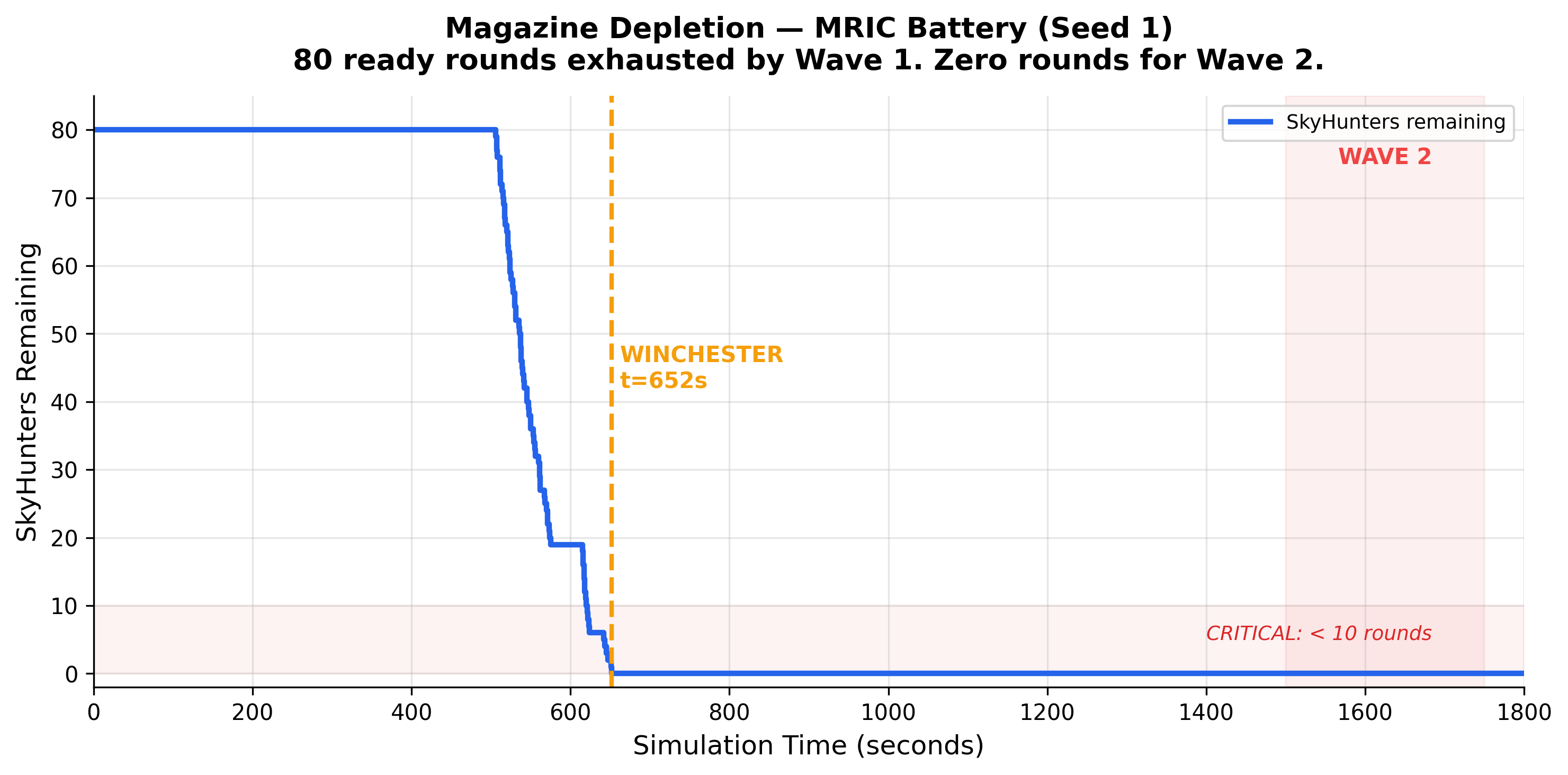
All 80 SkyHunter rounds were expended in 100% of seeds. The 80-round magazine services approximately 55 CJ-10s at the observed 1.44:1 efficiency. Wave 1 presents 48. The remaining ~11 rounds (80 - 48×1.44 ≈ 11) are consumed by the Wave 2 vanguard before the TELs go Winchester.
CEC-SALVO Discipline
Network-wide in-flight weapon tracking prevented launcher dogpiling across all 50 seeds. The CEC-SALVO system operates in Disciplined (shoot-look-shoot) mode against subsonic cruise missiles: one weapon pending per target, 5.0-second BDA confirmation window after resolution, re-engagement only after confirmed survival. This produced zero redundant engagements - every SkyHunter that left a TEL was assigned to a unique target or was a deliberate re-engagement after a confirmed near-miss.
The discipline is not free - the 5.0-second BDA window means the Fire Control Station (FCS) cannot immediately re-engage a survived target. Against 48 CJ-10s arriving over a 4-5 minute window, this pacing constraint shapes the engagement tempo. But the alternative - disabling S-L-S and firing pairs at every target - would consume 96 rounds against 48 targets and go Winchester before Wave 1 is complete.
Results - Wave 2 (12 CJ-10s, Double-Tap)
The Winchester Problem
Wave 2 launches at T+15 min from coastal Fujian and arrives at approximately T+28 min. By this time, the MRIC battery is functionally exhausted. The remaining SkyHunters (if any) engage the vanguard of Wave 2 - the baseline seed shows the last ~6 rounds intercepting CJ-10-49 through CJ-10-54 before all four TELs report Winchester.
The defense transitions from medium-range intercept to MADIS: Stingers at 4.8 km and the 30mm autocannon at 2 km. These are counter-UAS systems. Against Mach 0.75 cruise missiles carrying 500 kg warheads, they provide last-ditch resistance, not defense.
Cascade Destruction Sequence
T+13:48    Last SkyHunters engage Wave 2 vanguard at range.
           ~6 rounds across 4 TELs intercept CJ-10-49 through CJ-10-54.
           TELs go Winchester.

T+14:23    MADIS takes over. MADIS Mk1 engages with Stingers and 30mm.
           Gun kills CJ-10-56 and CJ-10-59. Stingers damage but cannot
           kill remaining CJ-10s fast enough.

T+14:38    Defense begins to collapse.
           CJ-10-55 destroys MADIS-I-2.
           CJ-10-57 destroys MRIC-TEL-3.
           CJ-10-58 destroys MRIC-TEL-4.
           CJ-10-60 destroys MADIS-II-2.
           Four defended assets destroyed. Half the battery is dead.

T+28:02    Surviving Wave 2 missiles enter terminal/impact window.
           12 CJ-10s inbound. Only MADIS-I-1 remains operational -
           one JLTV with 4 Stingers and a 30mm chain gun against
           12 cruise missiles.

T+28:02    MADIS-I-1 last stand.
  to       Fires Stingers at CJ-10-37, 38, 39.
T+28:12    NEAR_MISS, then HIT on each. Damage dealt but no kills.
           The crew knows what comes next.

T+28:16    CJ-10-37 destroys MADIS-I-1. Last kinetic defender gone.
           14 seconds of fighting as the sole remaining defender.

T+28:19    CJ-10-38 destroys G/ATOR-2.
T+28:20    CJ-10-39 destroys G/ATOR-1.
T+28:22    CJ-10-40 destroys MADIS-II-1. Fire control lost.
           The battery is blind.

T+28:26    CJ-10-41 destroys MRIC-TEL-1 (empty).
T+28:27    CJ-10-42 destroys MRIC-TEL-2 (empty).
           The PLARF doesn't know they're empty.

T+28:30    CJ-10-43 misses the airfield.
           GPS denial from the now-destroyed MADIS-II may have degraded
           this missile's terminal accuracy during approach through the
           spoofing zone. CEP shifted from 5m to 25m. The airfield is
           a large target - but 25m was enough to miss the runway.
           This is a single data point, not a validated EW effect.

T+28:34    CJ-10-44 destroys the airfield.

T+28:35    CJ-10-45 impacts already-destroyed SkyHunter debris.
T+28:37    CJ-10-46 impacts already-destroyed SkyHunter debris.
           Overkill. The PLARF sent 12 rounds at a target that needed 8.
           The reserve battery commander made the right call.

           -------- TOTAL ANNIHILATION --------
           Every BLUFOR asset on Shimoji-shima is destroyed or empty.
           Airfield cratered. Battery dead. Sensors dark.
           120-180 Marines on a 9.68 km² island with no air evacuation.
           Phase 2 has not begun.
MADIS-I-1: 14 Seconds
The last MADIS Mk1 - a single JLTV with four Stinger missiles and a 30mm chain gun - fought alone for approximately 14 seconds as the sole remaining defender after every other system was destroyed or Winchester. The crew fired Stingers at three inbound CJ-10s. They scored hits, dealt damage, but did not achieve kills fast enough. CJ-10-37 destroyed them at T+28:16.
Those 14 seconds are not a simulation artifact. They are the cost of a magazine-depth problem measured in human time. The crew in that truck was not there because they wanted to be. They were there because there was no one else left.
CJ-10-43: The Miss
CJ-10-43 missed the airfield at T+28:30. The now-destroyed MADIS-II-2 may have degraded this missile's BeiDou fix during its approach through the GPS spoofing zone, shifting CEP from ~5m to ~25m. Under BeiDou-denied guidance (INS + TERCOM + DSMAC), the missile's terminal accuracy degrades enough that a 25m miss is within the error distribution.
This is a single data point in a single seed. We note it because it is the only observable EW effect against a CJ-10 in the entire dataset. We do not claim the Modi II caused the miss - the link budget analysis shows the CRPA wall prevents reliable denial. But the data point exists, and intellectual honesty requires acknowledging it.
Results - Convergence & Statistics
50-Seed Monte Carlo Analysis
| Metric | Value |
|---|---|
| CJ-10s launched | 60 |
| CJ-10s killed (mean ± σ) | 55.6 ± 0.6 |
| Leakers (mean ± σ) | 4.4 ± 0.6 |
| Kill rate (mean ± SE) | 92.7% ± 1.0% |
| SE/mean ratio | 0.15% |
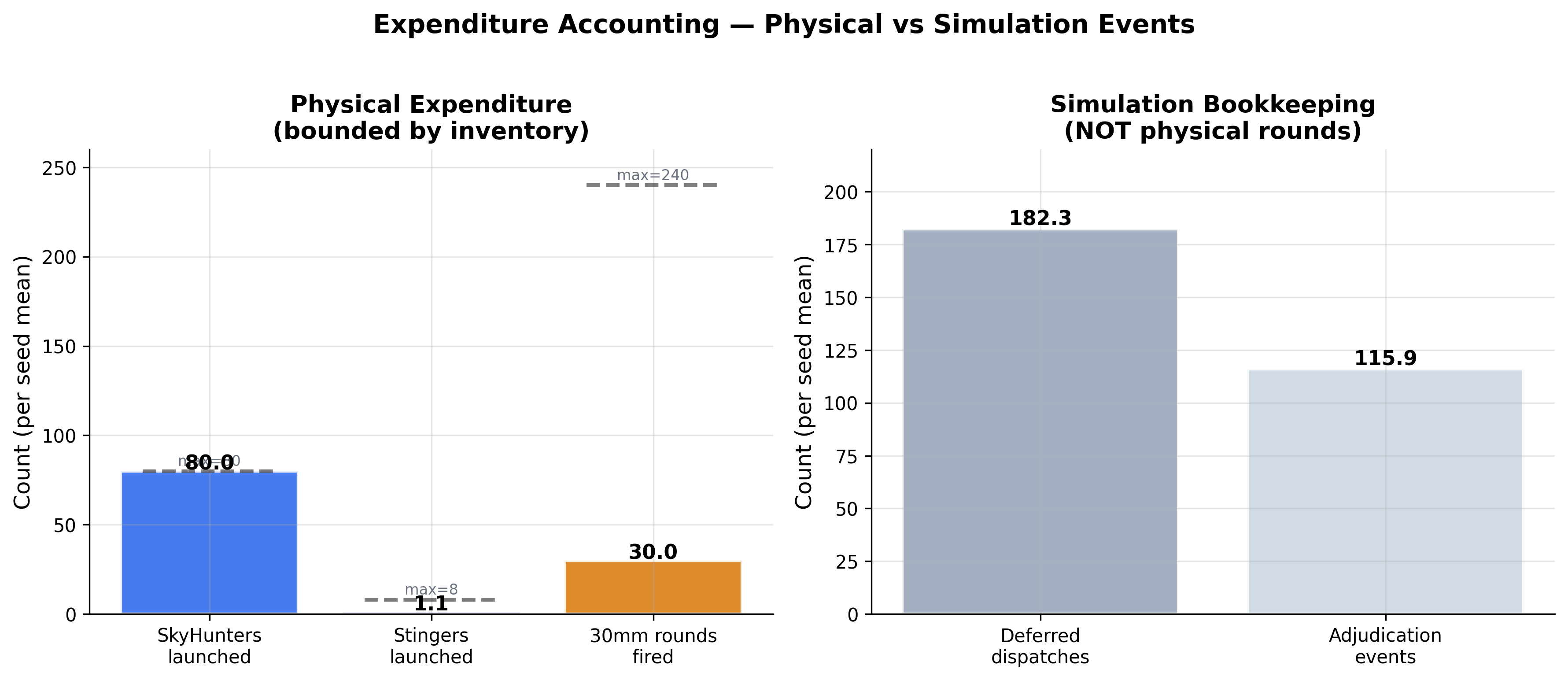
| SkyHunters launched | 80.0 ± 0.0 (Winchester 100%) |
| Stingers launched (mean ± σ) | 1.1 ± 0.3 |
| 30mm bursts fired (mean ± σ) | 2.0 ± 0.9 |
| 30mm rounds fired (mean ± σ) | 30 ± 13 |
| Airfield outcome | Destroyed (50/50 seeds) |
| MRIC outcome | Winchester / destroyed (50/50) |
Kill count distribution: 55 kills (40% of seeds), 56 kills (58% of seeds), 58 kills (2% of seeds). The variance is driven by CJ-10 terminal weave phase alignment - when the weave places the CJ-10 at favorable geometry during SkyHunter terminal, single-round kills reduce total expenditure and free rounds for additional targets.
Convergence: SE/mean = 0.15%. Converged by n=10 seeds. The kill rate stabilized at 92.7% with minimal variance after the first ten iterations, confirming that 50 seeds is more than sufficient for the reported precision.
Cost-Exchange Analysis
Per-Engagement Economics
BLUFOR losses (deterministic across all seeds):
| Asset | Qty Lost | Unit Cost | Total |
|---|---|---|---|
| SkyHunter rounds | 80 | $275K | $22.0M |
| Stinger rounds | ~1 | $450K | $0.5M |
| 30mm HEDP rounds | ~30 | $50 | $1.5K |
| AN/TPS-80 G/ATOR | 2 | $45M | $90.0M |
| MRIC TEL | 4 | $1.7M | $6.8M |
| MADIS Mk1 | 2 | $11.5M | $23.0M |
| MADIS Mk2 | 2 | $11.5M | $23.0M |
| Airfield infrastructure | 1 | - | - |
| BLUFOR total | $165.3M |
OPFOR expenditure:
| Asset | Qty | Unit Cost | Total |
|---|---|---|---|
| CJ-10 | 60 | $1.5-2.0M | $90-120M |
Exchange ratio: 1.4-1.8:1 favoring the attacker.
The Marines lose $165.3M in equipment and munitions. The PLARF spends $90-120M in CJ-10s. Even at a 92.7% kill rate, the defense pays more than the offense. The two G/ATORs alone ($90M) cost more than the entire low-end OPFOR expenditure estimate. However, it's important to remember in a real engagement that the number in the column doesn't represent the men and women who operate them.
Per-Engagement Unit Economics
Every SkyHunter that kills a CJ-10 is a $275K interceptor destroying a $1.5-2.0M missile. At the unit level, this appears favorable - a 5-7:1 cost exchange for the defender per engagement. But the defense also loses every platform on the island. The platforms are the real cost, not the interceptors. The G/ATORs, MRIC TELs, and MADIS vehicles represent $142.8M in hardware that is destroyed regardless of how many CJ-10s the SkyHunters kill.
This is the economic expression of the magazine-depth problem. The defense is not just losing the tactical fight after Wave 1 - it is losing the economic fight from the first shot.
Comparison to Quantifying Layered Naval Defense Against Hypersonic Glide Vehicles
In Quantifying Layered Naval Defense Against Hypersonic Glide Vehicles, the cost exchange was 97:1 in the attacker's favor - $24M in DF-17 HGVs destroying a $2.2B Burke plus $130M in interceptors. The First Island Chain scenario is less lopsided (1.4-1.8:1) because the CJ-10 is more expensive per round ($1.5-2.0M vs $3M for DF-17) and the defended assets are less expensive ($165M vs $2.3B). But the PLARF does not need a 97:1 ratio. At 1.4:1, the attacker can afford to keep shooting indefinitely. The 623rd Brigade has six battalions. At $90-120M per 60-round salvo, the full brigade can launch three salvos for $270-360M - less than the cost of a single F-35B.
Observations
What Worked
CEC-SALVO discipline. Network-wide shoot-look-shoot with in-flight weapon tracking prevented the most common failure mode in air defense simulations: multiple launchers independently engaging the same target. Zero redundant engagements across 50 seeds. This is the CAC2S surrogate earning its keep.
SkyHunter interceptor efficiency. At 1.44 rounds per kill against sea-skimming CJ-10s at 50m AGL with 2G terminal weave, the SkyHunter is performing near the theoretical ceiling for a blast-frag interceptor against this target class. The Tamir heritage - 90-95% commonality - is validated. The missile does what it was designed to do.
Sensor redundancy. Dual G/ATOR provided continuous track quality through Wave 1. The CEC-enabled sensor mesh meant no single radar loss would blind the battery. Both G/ATORs survived Wave 1 - they died in Wave 2 after the MRIC was Winchester.
MADIS as last-ditch layer. MADIS was not designed to fight cruise missiles. The 30mm gun killed two CJ-10s. The Stingers damaged three more. The MADIS Mk1 crews bought approximately 90 seconds of additional defense time against a threat class outside their designed engagement envelope. This is not a system failure - it is a system operating beyond its design parameters and still contributing.
What Did Not Work
Magazine depth. Eighty rounds is not enough. At the observed 1.44:1 efficiency, 80 SkyHunters services ~55 CJ-10s. The scenario presented 60. The 4-5 leaker gap is not an interceptor problem - it is an arithmetic problem. Six more SkyHunters and the airfield might survive. But "six more SkyHunters" means a fifth TEL, which means a fifth C-130 sortie to emplace it, which means more runway time at a contested airfield.
EW against hardened LACM guidance. The Modi II's GPS spoofing is designed for Group 1/2 SUAS with commercial GPS receivers. Against the CJ-10 with military BeiDou and CRPA, the system is physically incapable of achieving denial. The four-layer guidance stack (INS + BeiDou + TERCOM + DSMAC) means that even successful BeiDou denial only shifts CEP from 5m to 25m. The Modi II's EW contribution against LACMs is likely zero (other than our progenitor baseline scenario run), and this is a fundamental physics limitation - not a software fix.
Rearm logistics. Even if the airfield survived, the rearm race is unwinnable. SkyHunter weight (90 kg per round, 80 rounds = 7,200 kg) fits on a single KC-130J sortie. But the KC-130J must fly 300 km from Okinawa through contested airspace to land on an airfield that may be cratered. Each MRIC TEL requires a specialized reload vehicle with crane. The PLARF rearms faster - CJ-10 TELs are road-mobile, reload from pre-positioned dumps in the Fujian hills, and need no airfield. Reload cycle: 60-120 minutes per TEL. The 623rd Brigade can launch a third salvo before the Marines finish repairing the runway.
Discussion
Magazine Depth Is the Binding Constraint
The central finding of this research is not about interceptor performance, sensor quality, or fire control discipline. It is about magazine depth. The MRIC battery works. SkyHunter works. CEC-SALVO works. The system performs near its theoretical ceiling. And then the magazine runs out, and everything dies.
At 1.44 rounds per kill, the 80-round magazine has a kill capacity of approximately 55 CJ-10s. The scenario presents 60. The binding constraint is the number of ready rounds on the launchers, not the quality of the rounds. This is a logistics problem, not an engineering problem.
This is the arithmetic a sequential-exhaustion strategy exploits. Sequential exhaustion - launching cheap cruise missiles to drain expensive IADS magazines before committing high-value ballistic weapons - is not speculation about adversary doctrine. It is the logical strategy when you have more missiles than the defender has interceptors. The 623rd Brigade has six launch battalions. We tested two plus a reserve battery. The defense collapses at 60 rounds. The full brigade can launch 108+ in the first salvo, it matters not if they ripple fire or launch a few TELs at a time.
The Strategic Calculus: First Island Chain as Ablative Armor
From the PLARF's perspective, the First Island Chain airfields are ablative armor - obstacles to be burned through before the main effort against carrier strike groups and deep logistics nodes. The CJ-10 salvo against Miyakojima is not an end in itself. It is Phase 1 of a sequential campaign: drain IADS magazines, crater runways, blind sensors, then launch the DF-21D/DF-26/DF-17 salvos against the targets that matter.
From the attacker's perspective, the Marine position on Shimoji-shima is an obstacle to be burned through before the main effort against carrier strike groups and deep logistics nodes. The PLARF spends $90-120M in CJ-10s to remove a $165M obstacle and crater an airfield that supports fighter recovery and ISR operations. That is a trade the PLARF will make every time.
The DF-100 Problem
This research tested the CJ-10 - a subsonic, non-stealthy, thirty-year-old cruise missile design. The PLARF also fields the DF-100, a supersonic (Mach 3-4) land-attack cruise missile with a similar warhead class. If the PLARF substitutes DF-100 for CJ-10 in Wave 1, the engagement calculus changes fundamentally.
The SkyHunter travels at Mach 2.2. The DF-100 travels at Mach 3-4. This is the same speed-disadvantage problem that killed the Burke in Quantifying Layered Naval Defense Against Hypersonic Glide Vehicles - the interceptor cannot close the geometry before the threat reaches the defended asset. The engagement timeline compresses from minutes to seconds. The fire control loop gets fewer shots. The magazine-depth problem becomes a timeline problem.
We have not modeled DF-100 engagements. The physics suggest the outcome would be significantly worse than CJ-10 results. This is noted for future research.
What This Analysis Does Not Address
This study tests one configuration against one threat type. The findings should not be interpreted as "USMC IADS is useless." They should be interpreted as "80 SkyHunters is not enough magazine depth to survive the PLARF's Phase 1 doctrine against a single defended area." The broader defense architecture includes capabilities not modeled:
Allied IADS integration with JASDF. Japan operates Patriot PAC-3 batteries on Okinawa and the Home Islands. JASDF AWACS (E-767) provides airborne early warning. Integration with Japanese air defense extends detection range and provides engagement depth that organic USMC sensors cannot match. A combined US-Japan IADS on the Sakishima chain is a fundamentally different problem from what this research tests.
Multi-effector layering. Army Patriot or THAAD batteries - or Multi-Domain Task Force (MDTF) Typhons - deployed to Miyakojima can provide engagement depth and magazine capacity that MRIC alone cannot match. The Typhon launcher (4× Mk 41 cells) is a US Army system requiring C-17 airlift and is not USMC organic equipment. The Marines conducted Typhon familiarization training at Iwakuni (August 2025) but have no acquisition program.
Naval integration. An Aegis destroyer operating within CEC range of the island provides SM-6 outer-layer defense and dramatically extends the engagement timeline. But a Burke within 400 km of the Chinese coast is inside the DF-21D/DF-26 engagement envelope - which is why this scenario assumes the Navy cannot support.
Left-of-launch. Cyber operations against TEL command networks, Special Missions Units attacking seabed fiber optic sabotage, kinetic strike on launcher positions, space-based persistent tracking of mobile TELs. The most cost-effective interceptor is the one that destroys the missile on the ground. But the PLARF's TEL dispersal, reload logistics, and MILDEC make left-of-launch a find-fix-finish (F3) problem that ISR has not yet solved at the required timeline.
Forward Vector
The data points in one direction. The MRIC works but the magazine does not last. The question is what to do about it.
Deeper magazines. Six MRIC TELs (120 SkyHunters) instead of four. At the observed 1.44:1 efficiency, 120 rounds services approximately 83 CJ-10s - enough to absorb a full two-battalion salvo plus the double-tap with margin. The difference between annihilation and survival may be as few as six additional SkyHunters. The USMC plans 2,000 SkyHunter missiles across the program. The question is forward positioning and TEL count per battery, not procurement specifically. That said, this scenario only modeled a limited strike of an entire PLARF Brigade, in the case that any airfield in the First Island Chain is a priority first-strike target, far more batteries on the MTOE will be required.
Pre-positioned reload. SkyHunter weighs 90 kg per round. A palletized reload of 80 rounds weighs approximately 7,200 kg, well within KC-130J payload capacity. Pre-positioning reload stocks in hardened bunkers on Miyakojima before hostilities begin removes the contested-airspace airlift problem. The reload vehicle (crane-equipped) must also be pre-positioned. This is a logistics decision, not a technology problem. Any changes to the MRIC or even MADIS Mk. 2 to facilitate "hot reloads" or having entire packs that can be swapped out of the launchers themselves will likely improve survivability. The risk is sympathetic detonations or purposeful targeting, the first requires space and the second requires MILDEC and OPSEC.
Distributed hardened launchers. Four MRIC TELs clustered around the airfield perimeter present a concentrated target. Distributing launchers across Shimoji-shima and Irabu-jima with CEC connectivity via CAC2S provides geometric diversity and complicates the PLARF's targeting calculus. A CJ-10 aimed at a TEL position that kills the TEL but not the G/ATOR is a round wasted from the PLARF's perspective - but only if the remaining TELs have rounds to fire. However, this is making an assumption that a flight of J-16As with HARMs do not perform a simultaneous SEAD mission within a first strike on "day 0".
Allied IADS integration with JASDF. The Sakishima chain defense is not a USMC-only problem. Japan's Southwestern Composite Air Division operates Patriot batteries and JASDF radar sites that can integrate with MRIC via Link-16 or bilateral CEC architectures. Combined US-Japan magazine depth across the island chain changes the arithmetic fundamentally. While the Patriots can service CJ-10s, they should be kept in reserve for CJ-20s and CJ-100s not modeled in this scenario, expending PAC-3MSE on subsonic, sea-skimming LACMs is not the ideal usage outside of last-ditch "mad minute" engagements within the MADIS envelope (~30km).
Autonomous attritable interceptors. The cost-per-round arithmetic favors cheaper interceptors. SkyHunter at $275K per round killing a $1.5-2.0M CJ-10 is favorable at the unit level. But if the binding constraint is magazine depth, not cost-per-kill, then a cheaper interceptor that trades per-round lethality for magazine capacity may be the answer. A $50K attritable interceptor at 3:1 rounds-per-kill is $150K per kill versus $396K per kill for SkyHunter - and you can carry 440 of them on four TELs for the same total weight. All the better if these interceptors are meant to prosecute sea-skimming LACM threats. This theoretical battery could service ground-launched sub-sonic targets, keeping MRIC for air-launched CJ-20s and other SRBM targets.
Directed Energy Weapons organic to USMC GBAD. In line with cost asymmetry and defense-in-depth, DEW (specifically High-Energy Laser, HEL) in the ~50KW range is an emerging capability from Counter-Rocket, Artillery & Mortar (C-RAM) and Counter-UAS workloads (C-UAS). Another model we did not consider, as stated, is the usage of cheaper OWAs in the style of the Shahed-136 that could potentially be launched to cover magazine-depleting CJ-10/CJ-10A salvos. HELs can service these OWA threats, as well as other Group 4/5 MALE/HALE type ISR orbiters depending on the weather. This is not a novel concept, higher powered prototypes of HELs are being tested for carriers and the Department of Defense Directed Energy Weapons: Background and Issues for Congress from the Congressional Research Service in 2022 has undergone analysis of HELs as part of SHORAD and other systems. Higher powered systems in the 200-350KW range rely on technology that is still being developed, but would support servicing a wider range of incoming targets, at the expense of power requirements and weather sensitivity.
None of these are fast. None of them are cheap. But the MRIC battery on Shimoji-shima proved that the system works. It needs more rounds.
Author's Note
"Hold this island, Devils!"
From the Halls of Montezuma To the shores of Tripoli We fight our country's battles In the air, on land, and sea
"HOORAH!"
First to fight for right and freedom And to keep our honor clean We are proud to claim the title Of United States Marine.
By LCAC and by KC-130, network & comms Marines, EOD, air defense specialists, EW specialists, their support staff, aviators, and many other Marines are joined by their compatriots from coalition partners, the US Navy, the US Air Force, the Japanese Defense Forces, contractors, and a myriad of others. All of them - sons and daughters of their respective great nations - have come to the First Island Chain knowing what lies across the Strait.
Our flag's unfurled to every breeze From dawn to setting sun We have fought in ev'ry clime and place Where we could take a gun In the snow of far-off Northern lands And in sunny tropic scenes You will find us always on the job The United States Marines
Their objective and the typical refrain of the Corps' service members is a likely exchange that could happen between their OIC and themselves. Perhaps this exchange happens on the apron of Shimoji-shima Airfield on Miyakojima. Maybe before leaving Japan or Guam. Perhaps before they left their CONUS duty station. Whenever they got their orders they knew what it meant. Whether or not they knew this day would potentially be their last days depends. Information compartmentalization, misdirection, geostrategic politics, and all the sensors under the waves and in the vacuum of space may have prevented them from knowing. Deep down though, it's hard not to know.
Here's health to you and to our Corps Which we are proud to serve In many a strife we've fought for life And never lost our nerve If the Army and the Navy Ever look on Heaven's scenes They will find the streets are guarded By United States Marines.
Across the Strait, for weeks or longer, elements of the 623rd Brigade had moved their ready reserves from deep inland to the Fujian coast. These boys never had a Fallujah, or a Basra. They weren't on VBSS crews in SOUTHCOM. Their grandfather's wars are a long distant past. Their legacy is not sang aloud in hymn but carries across 100s of generations from the earliest Chinese Dynasties, to those who threw back Imperial Japan and avenged Nanking, to the Revolutionaries, and "War to Resist U.S. Aggression and Aid Korea". Much is made of their combat inexperience, these boys likely don't care or haven't heard.
Over the previous weeks and months, their support staff disembarked on trawlers, trains, trucks, and construction equipment to the coast. The leaders of the 623rd of the People's Liberation Army Rocket Force had made much fuss about these boys driving their road-mobile TELs down to the coast. They wanted to be seen, spotters flood social media and YouTube with videos. TELs, numerous ones. No ammo though.
Their officers receive the order from The Party in deep bases in Central China. Their targets are well known. They're stationary. They're rock and sand and tropical tree, disturbed by the most unstoppable force: mankind. He who breaks the rocks and rends the earth for tarmacs and towers and concrete pads. To bury their boots into the gravel and bring to bear their weapons of war to fight The Dragon.
On the Fujian coast it is a beautiful morning, the sun is coming up on the foothills and the coast, it would be beautiful. Quaint. The order is given, the tarps and camouflage netting are thrown back. The cabs of the launchers shake and rattle both bone and teeth and rock and dirt.
Fire belches forward out over the top of the cab and smoke fills the countryside, a sound shriller than all the chirps of birds and barking of dogs disturb the beautiful morning. Like so many silver dragons, the cruise missiles rake across the land and sea, claws hanging just above the water and fishermen rubbing the sleep from their eyes.
Back across the Strait things are normal, concerns are of dip spitters and radio batteries and some damn repellant for all of these mosquitos. It's also beautiful from the airfield's apron, the views blocked by launchers and KC130s and Sea Stallions. It smells of JP8, sweat, salt, and the sea. A call comes across the radio, something is coming. A great cataclysm. A god-wave. The G/ATORs have started to resolve that this won't be such a quiet morning anymore.
The radar returns aren't moving so fast. Good the Marines think to themselves, perhaps it's nothing, it's choppy in the strait after all and a ballistic missile would be moving much faster, and there would be vectors everywhere. Right?
"GIVE THEM HELL DEVILS!"
The battlecry would likely come with much more expletives as the Earth shakes as the MRICs give answer. Someone's dip spitter falls off the launcher trailer and spills on them, no matter, cannot worry about that anymore. The Devil Dogs have dogs of their own, SkyHunters fill the sky and burnt propellant fills the air, the salt gives way to the acrid smell of ordnance. The Devils send their hellhounds chasing after the dragons. They're not meant to give chase though, math and unknowable physics work against them. They are undone. The IFF falls off the radar tracks. The clusters are drawing near like you'd draw your woobie and poncho tight to your body during a monsoon.
Just as the Marines think it is over, the launchers re-engage. The cruise missiles are barely 20km away, an impossible distance to imagine across water, but in this land of war they aren't walking. The counter-salvo roars out and above the cacophony the Marines can barely make out the distant explosions. Good effects. Damn, those bastards got close!
"STATUS!?"
"We're up!"
A few cheers, a few whoops, perhaps a "HOORAH". There is still a job to be done, a lot of interceptors were fired. That was a lot of cruise missiles. Surely that is all, right? Marines run off to the kennels to fetch more hellhounds. They've survived but are desperately low on ready rounds. Across the Strait, there are too many ready rounds. The boys are in the cabs of their road-mobile launchers, they're shaking again, but this time from gravel and pot holes as they drive back to reload. Their fellow soldiers repeat the scene, throwing back more tarps and netting they inhale desire and expel fire.
"GET THE DAMN AMMO OVER HERE!"
On the apron, there is a buzz still, it takes too damn long to reload the launchers unlike the M27s or M16A4s. Frustration gives way to panic as alarms and radio calls disturb the chaos between the chaos that happens after a TIC.
"MORE INCOMING!"
Maybe the PLARF got word from one of their many orbital electric eyes, or someone on the island, a badly timed selfie taken amongst the burnt scrap metal - "missed us, f*ckers!". It matters at some level, in some force protection brief, but it does not matter now because our Marines have bigger issues to deal with. Twenty. Fifteen. Ten. Five. They can see them now just barely. The last SkyHunters fire, anything that was reloaded, anything that was left. It's not enough.
Like the sounds of industry the autocannons come alive, Stingers fly out of their tubes, whatever power is available the Modi II diverts to a last-ditch jamming effort.
Explosions. The concrete and gravel and asphalt that once kept the rock and sand of the island contained are heaved and torn. Aircraft, helicopters, MRIC batteries, radars, JLTVs. Instead of belching fire they erupt in a conflagration and pieces of metal and debris and anyone caught within the lethal radius of a 500 kg warhead are utterly destroyed.
The communication links die and the jammers die, the airfield has craters the size of above ground swimming pools but twice as deep. All around the First Island Chain a scene just like this one is playing out.
Without the cloud links and the autonomous software and the "left-click, right-click, left-click" target prosecution, you need to get behind the weapon system and its EO/IR screens (if they even still work) and attempt to engage Mach 0.75 sea skimmers with a 30mm autocannon and a Stinger missile meant for Counter-UAS.
I was never a good writer, certainly not for dramatizations. I understand that our simulation engine is far from perfect, there is always more math to be modeled and determinism to be stomped out. We will never be as good as classified Department of War or DIA wargaming engines because we don't have access to the true performance and deep level physics you really need to model these things with very high certainty.
However, we are building Empyrean Defense for the day the CEC goes dark, or the cloud link disappears. We are building the simulation engine now not just as a training modality but because these horrible questions need to be answered.
This dramatization was what went through my mind at 2:49am EST a few days before this research was published, but after the rough draft was done. I thought about my own experience as part of a unit, with the going-ons of the lower enlisted and salty NCOs and junior officers. About how mere mortals rise up to do great things in the face of impossible odds.
Our first run of this after we went through a (painful) exercise of refactoring and improving the 3-stage PN model, this is almost exactly how the situation played out. A screenshot from that run is down below. Perhaps it was just the stochasticity of the run, given the weather and random placements of threats that it just so happened a MADIS Mk. 1 was the last thing standing.
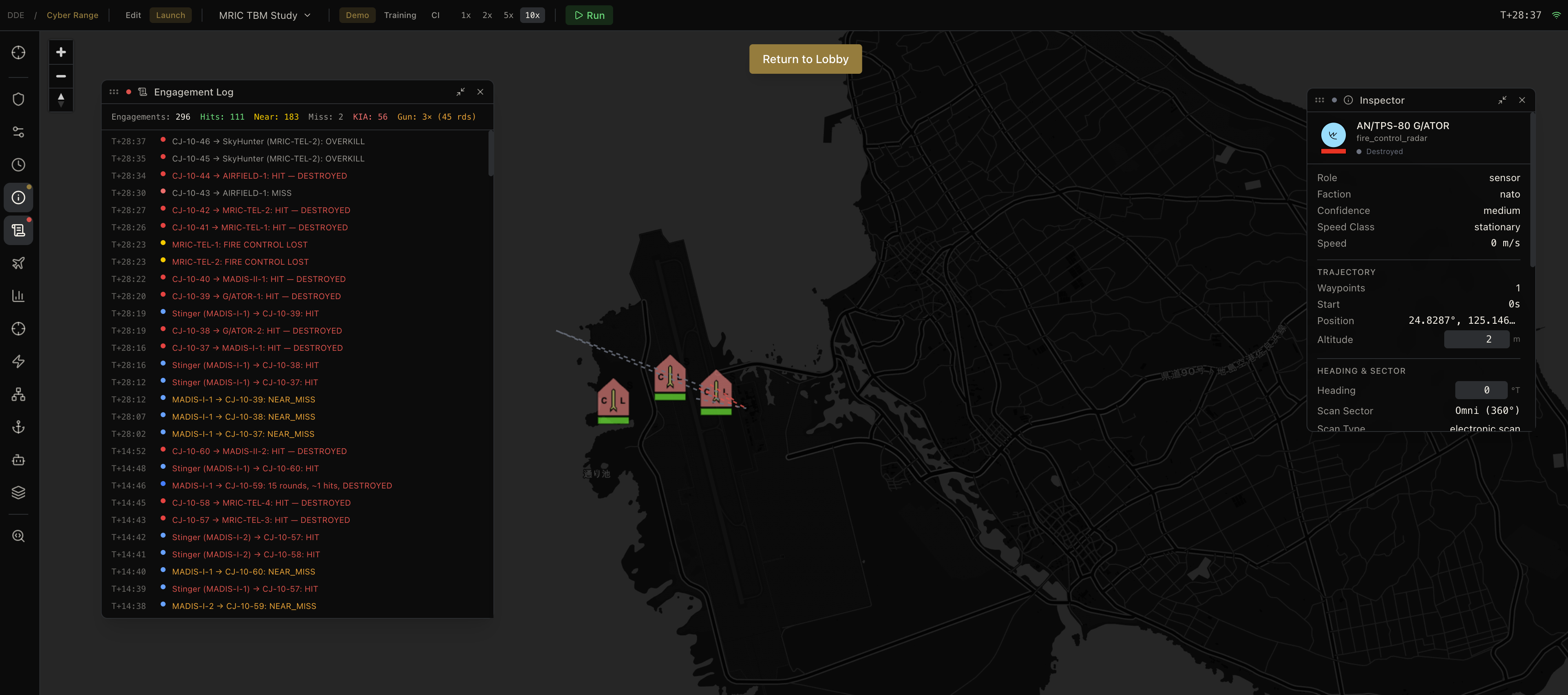
I can almost see the faces of the men crammed into the back of the MRAPs that are never quite big enough before FSRs stuff them with commo packages and cabling. They're desperately using thermals and a joystick that probably costs 100x too much to send whatever 30mm and Stingers they had left to buy their friends more time. In that scenario, the Marines place 30mm fire into three missiles and got another with a Stinger before the simulated missile landed within the lethal fragmentation zone of their JLTV and ripped it and the men inside asunder.
In the article Marines Realize They Can't Depend On Army For Ballistic Missile Defense from The War Zone (TWZ) by Joseph Trevithick, he relayed the words of Marine Lt. Col. Robert Barclay at the Modern Day Marine exposition on April 28, 2026. Lt. Col. Barclay was quoted by TWZ saying "we're exploring theater ballistic missile defense. So we're doing some studies, we're running some simulations, to see if that's a requirement for the service in the future." I doubt he will ever read this, but sir, you do need TBM defense.
And you need way more MRICs, and way more ammo. Put out a Topic or a BAA or scream it from the top of the Pentagon to get some smarter people to make these missiles and command uplinks more adaptable, to bring full end-to-end JADC2 to the lowest level Marine and to get more damn missiles.
I don't want this work of fiction from the previous paragraphs to become reality. The purpose of this research is not to make the opening fight feel inevitable. It is to make the cost of that fight impossible to ignore while there is still time to change the posture.
- Empyrean 7
References
- TWZ - "Marines Realizing They Can't Depend on Army Alone for Ballistic Missile Defense" (2026-04-29). Lt. Col. Barclay interview.
- Air University China Aerospace Studies Institute (CASI) - PLARF organizational structure and brigade composition. Launch battalion and TEL estimates.
- Grey Dynamics - PLARF ORBAT. 623rd Brigade identification and garrison locations.
- CSIS Missile Threat Project - Iron Dome / Tamir / SkyHunter specifications. CJ-10/DH-10 threat data.
- Breaking Defense - SkyHunter 90-95% Tamir commonality (2024).
- Defence-Industry.eu - MRIC $412.5M full-rate production contract (2025).
- mostlymissiledefense.com - Tamir detailed specifications.
- Missile Defense Advocacy Alliance (MDAA) - CJ-10/DH-10 LACM. 200-500 missiles, 40-55 launchers. Unit cost estimates.
- Northrop Grumman - AN/TPS-80 G/ATOR product page and published specifications.
- Military Watch Magazine - CJ-10 development history (2026).
- MISSILEDEFENSEADVOCACY.ORG - MADIS system overview.
- Army Recognition - MADIS full-rate production decision (December 2025).
- Kristensen, H.M. & Korda, M., Bulletin of the Atomic Scientists - PLARF force structure tables, Chinese nuclear and missile forces assessment.
- Springer (2018) - "Long-Term Characterization of Sea Conditions in the East China Sea Using Significant Wave Height and Wind Speed." Monthly wind 5.15-8.24 m/s, wave height 0.73-1.73m.
- Frontiers in Marine Science (2026) - East China Sea annual mean wave height 1.2-1.7m.
- Zarchan, P. Tactical and Strategic Missile Guidance (7th ed.). AIAA Progress in Astronautics and Aeronautics, 2019.
- Sutton, G.P. & Biblarz, O. Rocket Propulsion Elements (9th ed.). Wiley, 2017.
- Kingery, C.N. & Bulmash, G. "Air Blast Parameters from TNT Spherical Air Burst and Hemispherical Surface Burst." BRL Technical Report 02555, U.S. Army Ballistic Research Laboratory, 1984.
- Gurney, R.W. "The Initial Velocities of Fragments from Bombs, Shells, and Grenades." BRL Report 405, 1943.
- Mott, N.F. "Fragmentation of Shell Cases." Proceedings of the Royal Society, 1947.
- McCoy, R.L. Modern Exterior Ballistics (2nd ed.). Schiffer Military History, 2012.
- Fleeman, E.L. Tactical Missile Design (2nd ed.). AIAA, 2006.
- Skolnik, M. Introduction to Radar Systems (3rd ed.). McGraw-Hill, 2001.
- Defense Post - MRIC acquisition timeline and Marine Aircraft Wing deployment plan (August 2023).
- Defense News - SkyHunter/MRIC procurement and IOC timeline (January 2024).
Empyrean Defense Research Brief - May 2026
UNCLASSIFIED // OPEN SOURCE INTELLIGENCE ONLY