Cyber as a first-class sensor domain. Coming soon.
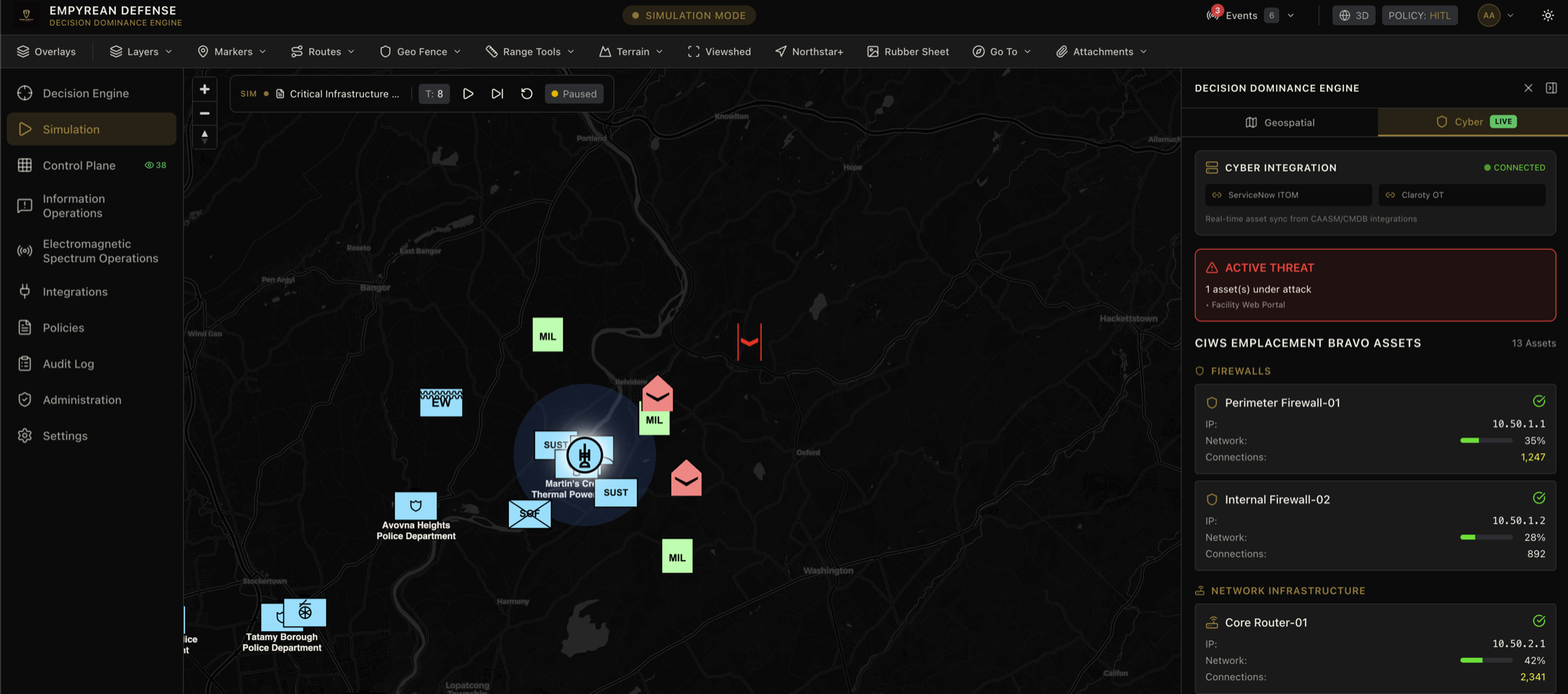
Empyrean Cyber Operations (CyOps) will extend the platform with OCSF-native cyber enrichment, anomaly detection, offensive assessment tooling, and cross-domain correlation that joins cyber observables to RF, space, narrative, and geospatial signals already flowing through the fusion architecture. Not a SIEM. Not an EDR. The layer that makes cyber a first-class domain in a platform that already fuses the others.
Cyber Operations is in active development. The architecture, entity model, and cross-domain correlation design are complete. We are building toward phased delivery starting with OCSF ingestion and enrichment, followed by anomaly detection, offensive assessment tooling, and full cross-domain correlation. Our founding team brings 25 years of combined cyber and security data operations expertise across cloud security, application security, offensive security, enterprise security, and physical security.
We are looking for design partners who want to shape this capability from the ground up. If your organization operates at the intersection of cyber, physical, and electromagnetic security, we want to build with you.
The Problem
Adversary operations are multi-domain. An APT intrusion campaign may coincide with influence operations, targeted RF interference, or reconnaissance satellite passes. No pure-cyber tool surfaces these compound indicators because no pure-cyber tool has access to the RF, space, narrative, and geospatial signals that complete the picture. Meanwhile, security teams run separate tools for IT, OT, and physical security with no correlation layer between them. CyOps is being built to close that gap - OCSF-native ingestion from your existing EDR, SIEM, and identity stack, enriched through a staged pipeline, with anomaly detection and policy-driven response that correlates across every domain Empyrean already covers.
Who Has This Problem
Key Workflows
Capabilities
Platform Integration
CyOps is designed as a seventh domain in the existing DDE architecture. Cyber entities render on the COP alongside physical tracks. Cyber anomalies feed the fusion engine and trigger automated decision rules when correlated with RF, narrative, space, or physical signals. The Policy Engine evaluates compound conditions across all domains - an authentication anomaly coinciding with an EMSO emitter detection and a narrative campaign spike becomes a single correlated alert, not three separate tickets in three separate tools.
Related Resources & Insights
What is Digital Force Protection?
Digital Force Protection explained: countering ubiquitous technical surveillance through device census, co-traveler analysis, signature management, and fused defensive measurement.
What is Intelligence Fusion?
Intelligence fusion explained: JDL/DFIG model, multi-INT disciplines, JADC2, and what fusion means for civilian operators.
What is Maritime Intelligence?
Maritime intelligence explained: AIS limits, dark vessels, beneficial ownership, sanctions risk, and multi-INT fusion at sea.
What is OPSEC?
OPSEC, UTS, and Digital Force Protection explained: the five-step process, five threat vectors, and signature management.
What is ATAK?
ATAK explained: TAK clients, EUDs, data packages, mesh networks, federation, plugins, and the CoT protocol that ties it together.
Defense & Intelligence Glossary
Defense & intelligence glossary: acronyms and terms for EMSO, C-UAS, JADC2, sensor fusion, SSA, CTF, entity resolution, and TAK.
What is Counter Threat Finance?
Counter Threat Finance (CTF) explained: DoDD 5205.14 doctrine, CTF vs. AML, sanctions, shell companies, TBML, and operational software.
What is Entity Resolution?
Entity Resolution explained: deterministic, probabilistic, ML, and graph methods for matching records to real-world identities.
What is Narrative Intelligence?
Narrative Intelligence (NARINT) explained: detecting and countering influence operations, DISARM framework, CIB, and OSINT.
What is EMSO?
EMSO explained: Electronic Warfare, EMBM, JEMSO, Electronic Order of Battle, CEMA, spectrum management, and operational software.
What is a Common Operational Picture?
Common Operational Picture (COP) explained: why most COPs fail, display vs. decision surface, edge deployment, and true fusion.
What is Space Situational Awareness?
Space Situational Awareness (SSA) explained: orbital tracking, TLEs, the Space Surveillance Network, and counterspace threats.
What is Counter-UAS?
Counter-UAS (C-UAS) explained: sensors, fusion, effectors, legal authorities, and layered drone defense for military and critical sites.
What is JADC2?
JADC2 explained: why top-down fails, what sensor-up architecture means, and why edge-deployed fusion survives contact.
What is Sensor Fusion?
Sensor fusion explained: state estimation, data association, multi-hypothesis tracking, identity provenance, and edge deployment.
High-Powered Microwave (HPM): From Hard Kill to Residual Risk
3,400 Monte Carlo runs reveal HPM's service-rate ceiling, residual warhead hazard, and cascade failure against 40-400 drone swarms.
The Devil Dog and the Dragon: USMC IADS vs. PLARF Cruise Missile Saturation
USMC MRIC vs 60 CJ-10 cruise missiles: 92.7% kill rate, then magazine exhaustion at T+28:37. The Marines need more rounds.
Quantifying Layered Naval Defense Against Hypersonic Glide Vehicles
DF-17 HGV vs Arleigh Burke: 50 Monte Carlo seeds, SM-6 at 23% kill rate, PAC-3 at zero. The timeline is the constraint.
Ubiquitous Technical Surveillance Will Get You Killed on the Streets
How commercial location data, advertising identifiers, co-travel analysis, and data fusion expose military personnel—and what digital force protection can do.
Maritime Domain Awareness: The Complete Field Guide
Maritime domain awareness field guide: spectrum, seabed, ownership, and cyber threats that single-domain tools miss.
TAK Server on AWS: From Zero to Operational in Under Ten Minutes
Deploy TAK Server on AWS with CloudFormation: TLS, Docker, hardening, and security best practices in under ten minutes.
Release Log Vol. 1: Maritime Intelligence & UAS Traffic Management
Empyrean ships Maritime Intelligence, Air Domain Intelligence, and UAS Traffic Management with 20+ data sources and FAA enrichment.
The Environment Is Trying to Kill Your Mission. We Want to Mitigate It.
Weather & environmental intelligence that modifies sensor confidence, route feasibility, and UAS BVLOS risk in real time.
EMSO Is Everyone's Problem. Let's Do Something About It.
EMSO deep dive: EW history, doctrinal evolution to CEMA, cross-domain effects, and what operators can do about it today.
Would the Real Common Operating Picture (COP) Please Stand Up
Most COPs are PowerPoint and uncorrelated feeds. What a real COP requires: fusion, policy, edge deployment, and echelon logic.
Building Physics-Backed, Unclassified, Open-Source Defense Research
Introducing Empyrean Defense Research: unclassified, physics-backed wargaming. First drop: 1,500 Monte Carlo sims of DF-17 vs DDG.
How the Space Domain Impacts Your Operations
Space domain impacts on EW, ground, maritime, air, and information ops — and what you can do to counter them.
Sense, Make Sense, Act: How to Conduct Counter-UAS From Sensors to Deployments
Counter-UAS playbook: 8 sensor types, fusion methods, jam vs. shoot decisions, and layered drone defense for DDIL environments.
Why JADC2 Needs Sensor Fusion at the Edge
JADC2 assumes persistent cloud and top-down authority. Operators have neither. Why sensor fusion must live at the edge.
What is Digital Force Protection?
Digital Force Protection explained: countering ubiquitous technical surveillance through device census, co-traveler analysis, signature management, and fused defensive measurement.
What is Intelligence Fusion?
Intelligence fusion explained: JDL/DFIG model, multi-INT disciplines, JADC2, and what fusion means for civilian operators.
What is Maritime Intelligence?
Maritime intelligence explained: AIS limits, dark vessels, beneficial ownership, sanctions risk, and multi-INT fusion at sea.
What is OPSEC?
OPSEC, UTS, and Digital Force Protection explained: the five-step process, five threat vectors, and signature management.
What is ATAK?
ATAK explained: TAK clients, EUDs, data packages, mesh networks, federation, plugins, and the CoT protocol that ties it together.
Defense & Intelligence Glossary
Defense & intelligence glossary: acronyms and terms for EMSO, C-UAS, JADC2, sensor fusion, SSA, CTF, entity resolution, and TAK.
What is Counter Threat Finance?
Counter Threat Finance (CTF) explained: DoDD 5205.14 doctrine, CTF vs. AML, sanctions, shell companies, TBML, and operational software.
What is Entity Resolution?
Entity Resolution explained: deterministic, probabilistic, ML, and graph methods for matching records to real-world identities.
What is Narrative Intelligence?
Narrative Intelligence (NARINT) explained: detecting and countering influence operations, DISARM framework, CIB, and OSINT.
What is EMSO?
EMSO explained: Electronic Warfare, EMBM, JEMSO, Electronic Order of Battle, CEMA, spectrum management, and operational software.
What is a Common Operational Picture?
Common Operational Picture (COP) explained: why most COPs fail, display vs. decision surface, edge deployment, and true fusion.
What is Space Situational Awareness?
Space Situational Awareness (SSA) explained: orbital tracking, TLEs, the Space Surveillance Network, and counterspace threats.
What is Counter-UAS?
Counter-UAS (C-UAS) explained: sensors, fusion, effectors, legal authorities, and layered drone defense for military and critical sites.
What is JADC2?
JADC2 explained: why top-down fails, what sensor-up architecture means, and why edge-deployed fusion survives contact.
What is Sensor Fusion?
Sensor fusion explained: state estimation, data association, multi-hypothesis tracking, identity provenance, and edge deployment.
High-Powered Microwave (HPM): From Hard Kill to Residual Risk
3,400 Monte Carlo runs reveal HPM's service-rate ceiling, residual warhead hazard, and cascade failure against 40-400 drone swarms.
The Devil Dog and the Dragon: USMC IADS vs. PLARF Cruise Missile Saturation
USMC MRIC vs 60 CJ-10 cruise missiles: 92.7% kill rate, then magazine exhaustion at T+28:37. The Marines need more rounds.
Quantifying Layered Naval Defense Against Hypersonic Glide Vehicles
DF-17 HGV vs Arleigh Burke: 50 Monte Carlo seeds, SM-6 at 23% kill rate, PAC-3 at zero. The timeline is the constraint.
Ubiquitous Technical Surveillance Will Get You Killed on the Streets
How commercial location data, advertising identifiers, co-travel analysis, and data fusion expose military personnel—and what digital force protection can do.
Maritime Domain Awareness: The Complete Field Guide
Maritime domain awareness field guide: spectrum, seabed, ownership, and cyber threats that single-domain tools miss.
TAK Server on AWS: From Zero to Operational in Under Ten Minutes
Deploy TAK Server on AWS with CloudFormation: TLS, Docker, hardening, and security best practices in under ten minutes.
Release Log Vol. 1: Maritime Intelligence & UAS Traffic Management
Empyrean ships Maritime Intelligence, Air Domain Intelligence, and UAS Traffic Management with 20+ data sources and FAA enrichment.
The Environment Is Trying to Kill Your Mission. We Want to Mitigate It.
Weather & environmental intelligence that modifies sensor confidence, route feasibility, and UAS BVLOS risk in real time.
EMSO Is Everyone's Problem. Let's Do Something About It.
EMSO deep dive: EW history, doctrinal evolution to CEMA, cross-domain effects, and what operators can do about it today.
Would the Real Common Operating Picture (COP) Please Stand Up
Most COPs are PowerPoint and uncorrelated feeds. What a real COP requires: fusion, policy, edge deployment, and echelon logic.
Building Physics-Backed, Unclassified, Open-Source Defense Research
Introducing Empyrean Defense Research: unclassified, physics-backed wargaming. First drop: 1,500 Monte Carlo sims of DF-17 vs DDG.
How the Space Domain Impacts Your Operations
Space domain impacts on EW, ground, maritime, air, and information ops — and what you can do to counter them.
Sense, Make Sense, Act: How to Conduct Counter-UAS From Sensors to Deployments
Counter-UAS playbook: 8 sensor types, fusion methods, jam vs. shoot decisions, and layered drone defense for DDIL environments.
Why JADC2 Needs Sensor Fusion at the Edge
JADC2 assumes persistent cloud and top-down authority. Operators have neither. Why sensor fusion must live at the edge.
What is Digital Force Protection?
Digital Force Protection explained: countering ubiquitous technical surveillance through device census, co-traveler analysis, signature management, and fused defensive measurement.
What is Intelligence Fusion?
Intelligence fusion explained: JDL/DFIG model, multi-INT disciplines, JADC2, and what fusion means for civilian operators.
What is Maritime Intelligence?
Maritime intelligence explained: AIS limits, dark vessels, beneficial ownership, sanctions risk, and multi-INT fusion at sea.
What is OPSEC?
OPSEC, UTS, and Digital Force Protection explained: the five-step process, five threat vectors, and signature management.
What is ATAK?
ATAK explained: TAK clients, EUDs, data packages, mesh networks, federation, plugins, and the CoT protocol that ties it together.
Defense & Intelligence Glossary
Defense & intelligence glossary: acronyms and terms for EMSO, C-UAS, JADC2, sensor fusion, SSA, CTF, entity resolution, and TAK.
What is Counter Threat Finance?
Counter Threat Finance (CTF) explained: DoDD 5205.14 doctrine, CTF vs. AML, sanctions, shell companies, TBML, and operational software.
What is Entity Resolution?
Entity Resolution explained: deterministic, probabilistic, ML, and graph methods for matching records to real-world identities.
What is Narrative Intelligence?
Narrative Intelligence (NARINT) explained: detecting and countering influence operations, DISARM framework, CIB, and OSINT.
What is EMSO?
EMSO explained: Electronic Warfare, EMBM, JEMSO, Electronic Order of Battle, CEMA, spectrum management, and operational software.
What is a Common Operational Picture?
Common Operational Picture (COP) explained: why most COPs fail, display vs. decision surface, edge deployment, and true fusion.
What is Space Situational Awareness?
Space Situational Awareness (SSA) explained: orbital tracking, TLEs, the Space Surveillance Network, and counterspace threats.
What is Counter-UAS?
Counter-UAS (C-UAS) explained: sensors, fusion, effectors, legal authorities, and layered drone defense for military and critical sites.
What is JADC2?
JADC2 explained: why top-down fails, what sensor-up architecture means, and why edge-deployed fusion survives contact.
What is Sensor Fusion?
Sensor fusion explained: state estimation, data association, multi-hypothesis tracking, identity provenance, and edge deployment.
High-Powered Microwave (HPM): From Hard Kill to Residual Risk
3,400 Monte Carlo runs reveal HPM's service-rate ceiling, residual warhead hazard, and cascade failure against 40-400 drone swarms.
The Devil Dog and the Dragon: USMC IADS vs. PLARF Cruise Missile Saturation
USMC MRIC vs 60 CJ-10 cruise missiles: 92.7% kill rate, then magazine exhaustion at T+28:37. The Marines need more rounds.
Quantifying Layered Naval Defense Against Hypersonic Glide Vehicles
DF-17 HGV vs Arleigh Burke: 50 Monte Carlo seeds, SM-6 at 23% kill rate, PAC-3 at zero. The timeline is the constraint.
Ubiquitous Technical Surveillance Will Get You Killed on the Streets
How commercial location data, advertising identifiers, co-travel analysis, and data fusion expose military personnel—and what digital force protection can do.
Maritime Domain Awareness: The Complete Field Guide
Maritime domain awareness field guide: spectrum, seabed, ownership, and cyber threats that single-domain tools miss.
TAK Server on AWS: From Zero to Operational in Under Ten Minutes
Deploy TAK Server on AWS with CloudFormation: TLS, Docker, hardening, and security best practices in under ten minutes.
Release Log Vol. 1: Maritime Intelligence & UAS Traffic Management
Empyrean ships Maritime Intelligence, Air Domain Intelligence, and UAS Traffic Management with 20+ data sources and FAA enrichment.
The Environment Is Trying to Kill Your Mission. We Want to Mitigate It.
Weather & environmental intelligence that modifies sensor confidence, route feasibility, and UAS BVLOS risk in real time.
EMSO Is Everyone's Problem. Let's Do Something About It.
EMSO deep dive: EW history, doctrinal evolution to CEMA, cross-domain effects, and what operators can do about it today.
Would the Real Common Operating Picture (COP) Please Stand Up
Most COPs are PowerPoint and uncorrelated feeds. What a real COP requires: fusion, policy, edge deployment, and echelon logic.
Building Physics-Backed, Unclassified, Open-Source Defense Research
Introducing Empyrean Defense Research: unclassified, physics-backed wargaming. First drop: 1,500 Monte Carlo sims of DF-17 vs DDG.
How the Space Domain Impacts Your Operations
Space domain impacts on EW, ground, maritime, air, and information ops — and what you can do to counter them.
Sense, Make Sense, Act: How to Conduct Counter-UAS From Sensors to Deployments
Counter-UAS playbook: 8 sensor types, fusion methods, jam vs. shoot decisions, and layered drone defense for DDIL environments.
Why JADC2 Needs Sensor Fusion at the Edge
JADC2 assumes persistent cloud and top-down authority. Operators have neither. Why sensor fusion must live at the edge.
Become a CyOps design partner
We're looking for organizations at the intersection of cyber, physical, and electromagnetic security who want to shape this capability from day one. 25 years of combined SecDataOps expertise. Let's build together.