Know your environment before your adversary does.
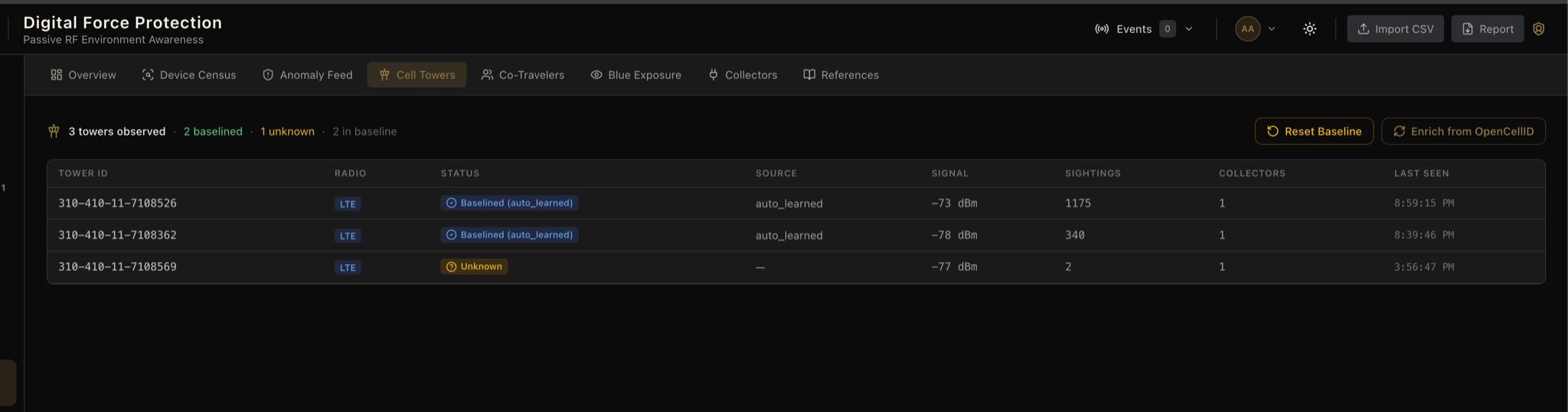
Passive device environment awareness that tells operators what wireless devices are present in their area of operations, detects anomalous infrastructure like rogue access points and IMSI catchers, identifies co-traveling device patterns, and assesses blue-force electronic exposure. Ubiquitous Technical Surveillance (UTS) for sanctioned observation operations - passive collection only, no active electronic warfare - giving you the same wireless picture an adversary would build, so you see it first.
The Problem
Your force radiates. Every phone, every Bluetooth device, every WiFi access point broadcasts presence data that an adversary can collect, correlate, and exploit. Most units have zero visibility into their own electronic signature or the surveillance infrastructure around them. A rogue AP near the TOC exfiltrates data. An IMSI catcher near the gate maps every phone that passes. A co-traveling device follows your patrol across three positions. You don't know because you've never looked. This is Ubiquitous Technical Surveillance - the adversary is already doing it to you. DFP gives you that same passive observation capability under sanctioned, auditable operations. No active EW. No jamming. Observation and assessment only - but with the depth to know what devices are present, where they are, who they belong to, and what that means for your security posture.
Who Has This Problem
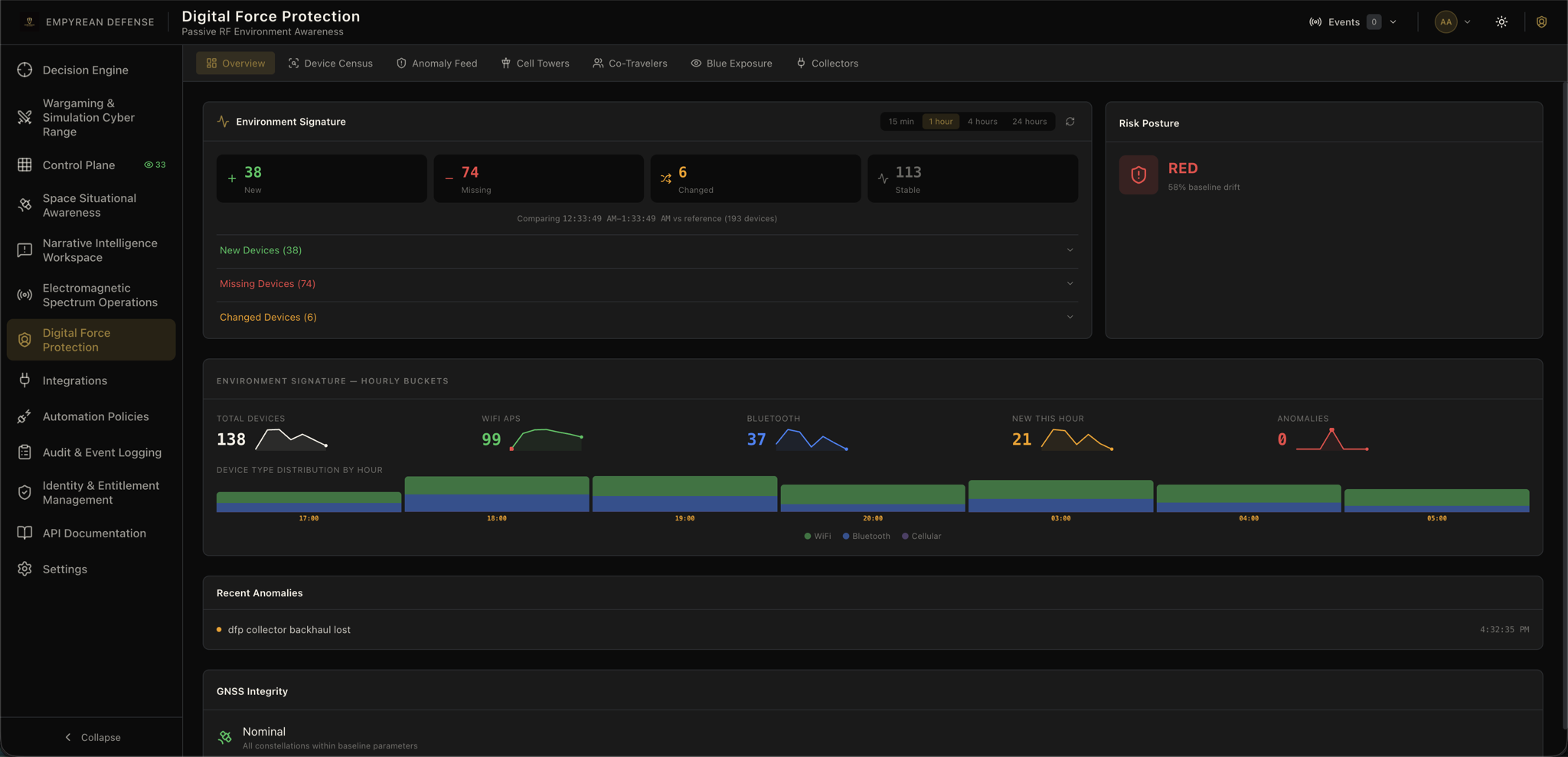
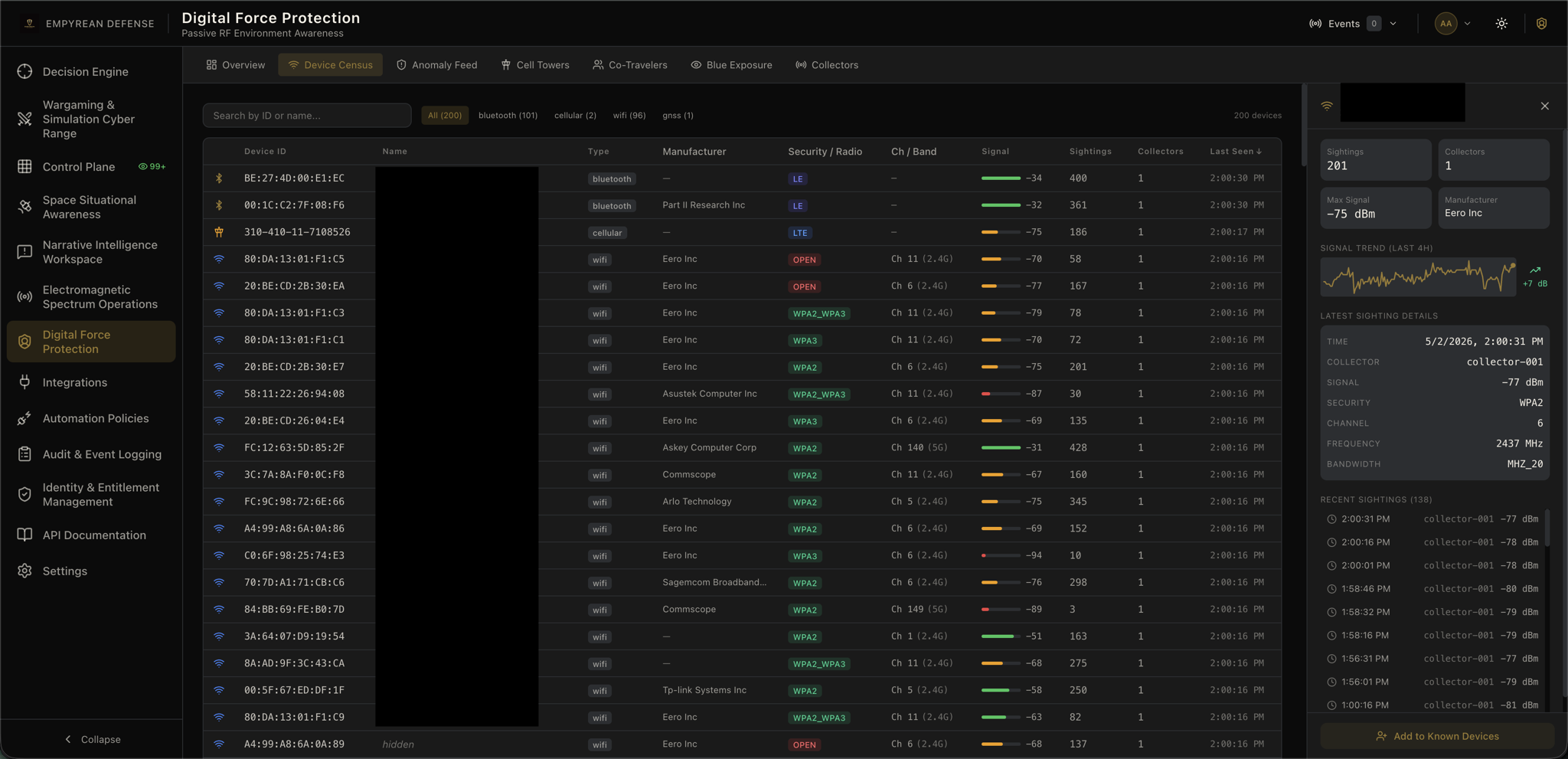
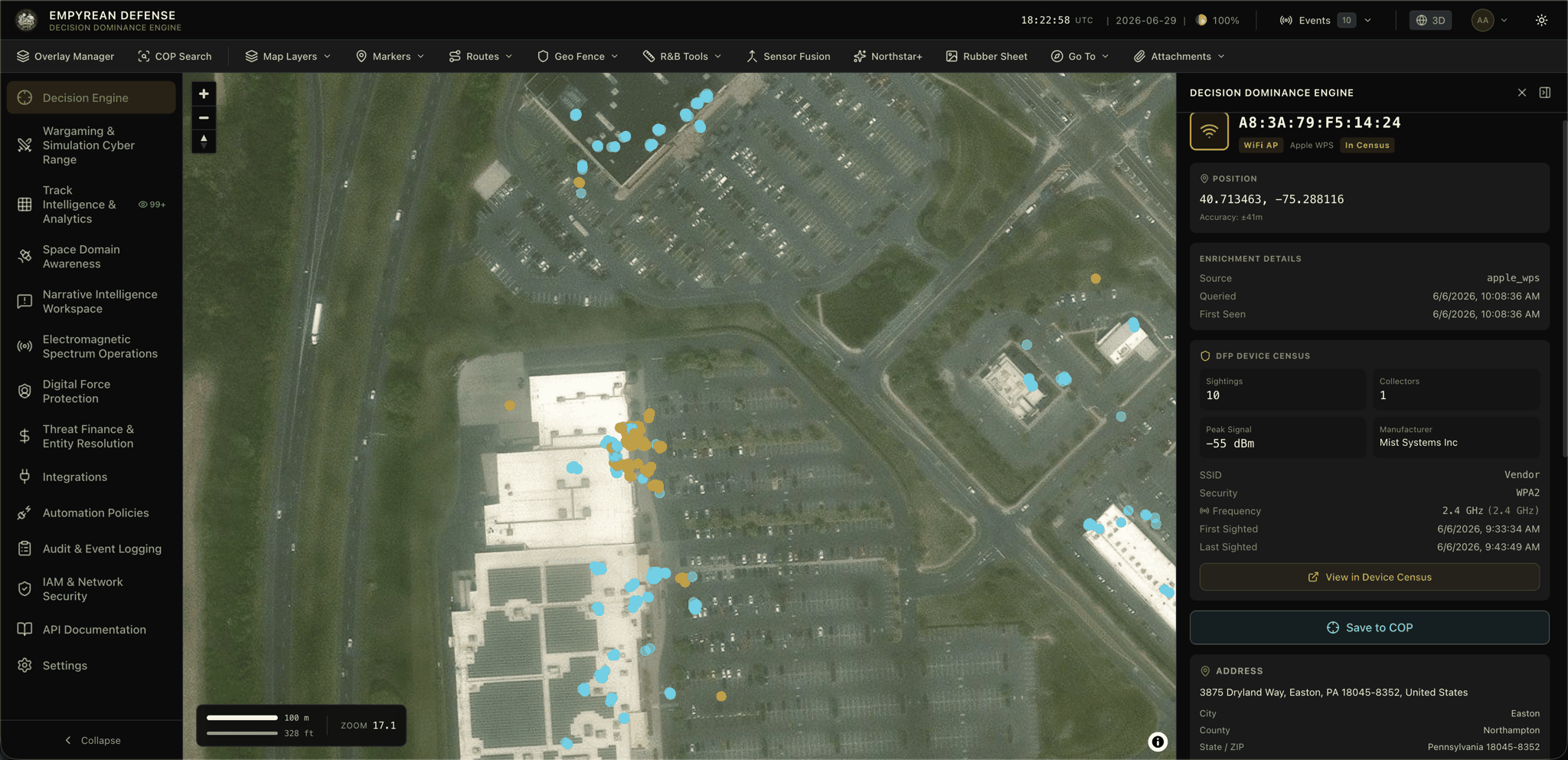
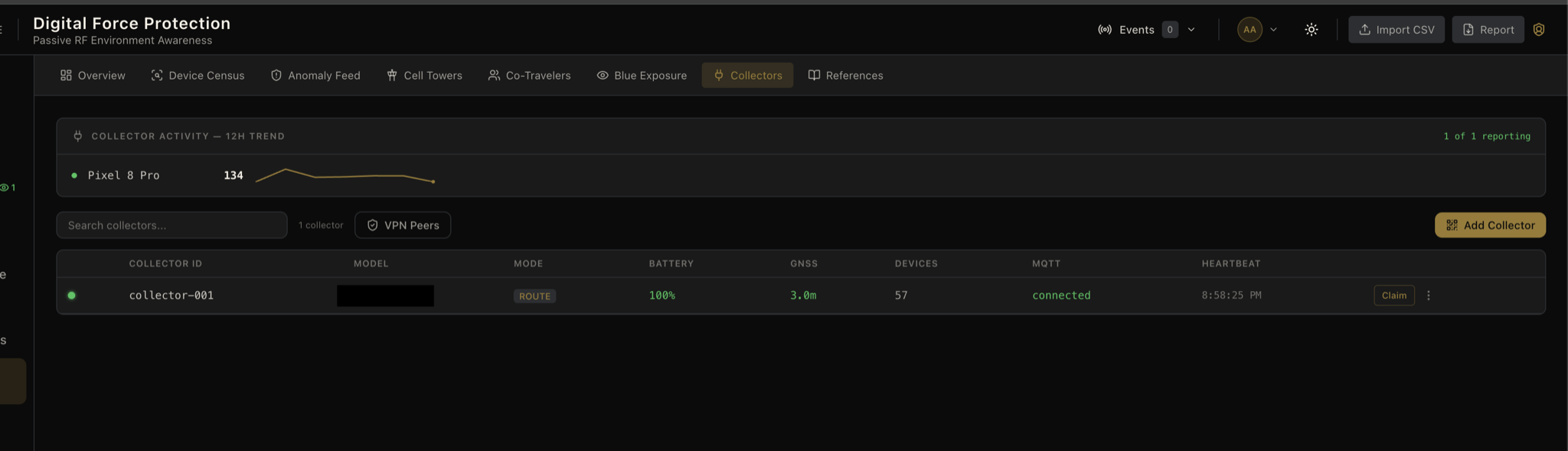
Key Workflows
Capabilities
Platform Integration
DFP is its own analytical domain with its own workspace, ingest pipeline, and engines. It cross-correlates with EMSO (frequency, position, and time join for SDR corroboration), provides cellular RSRP ground-truth that calibrates EMSO propagation models, feeds the Policy Engine with 18 condition types for automated response, and renders collector positions and anomaly clusters on the COP. GNSS integrity observations complement SSA's space-side constellation awareness. Future integration with Cyber Operations via MAC address join and with Narrative Intelligence via geospatial device-to-identity correlation.
Related Resources & Insights
What is Digital Force Protection?
Digital Force Protection explained: countering ubiquitous technical surveillance through device census, co-traveler analysis, signature management, and fused defensive measurement.
What is Intelligence Fusion?
Intelligence fusion explained: JDL/DFIG model, multi-INT disciplines, JADC2, and what fusion means for civilian operators.
What is Maritime Intelligence?
Maritime intelligence explained: AIS limits, dark vessels, beneficial ownership, sanctions risk, and multi-INT fusion at sea.
What is OPSEC?
OPSEC, UTS, and Digital Force Protection explained: the five-step process, five threat vectors, and signature management.
What is ATAK?
ATAK explained: TAK clients, EUDs, data packages, mesh networks, federation, plugins, and the CoT protocol that ties it together.
Defense & Intelligence Glossary
Defense & intelligence glossary: acronyms and terms for EMSO, C-UAS, JADC2, sensor fusion, SSA, CTF, entity resolution, and TAK.
What is Counter Threat Finance?
Counter Threat Finance (CTF) explained: DoDD 5205.14 doctrine, CTF vs. AML, sanctions, shell companies, TBML, and operational software.
What is Entity Resolution?
Entity Resolution explained: deterministic, probabilistic, ML, and graph methods for matching records to real-world identities.
What is Narrative Intelligence?
Narrative Intelligence (NARINT) explained: detecting and countering influence operations, DISARM framework, CIB, and OSINT.
What is EMSO?
EMSO explained: Electronic Warfare, EMBM, JEMSO, Electronic Order of Battle, CEMA, spectrum management, and operational software.
What is a Common Operational Picture?
Common Operational Picture (COP) explained: why most COPs fail, display vs. decision surface, edge deployment, and true fusion.
What is Space Situational Awareness?
Space Situational Awareness (SSA) explained: orbital tracking, TLEs, the Space Surveillance Network, and counterspace threats.
What is Counter-UAS?
Counter-UAS (C-UAS) explained: sensors, fusion, effectors, legal authorities, and layered drone defense for military and critical sites.
What is JADC2?
JADC2 explained: why top-down fails, what sensor-up architecture means, and why edge-deployed fusion survives contact.
What is Sensor Fusion?
Sensor fusion explained: state estimation, data association, multi-hypothesis tracking, identity provenance, and edge deployment.
High-Powered Microwave (HPM): From Hard Kill to Residual Risk
3,400 Monte Carlo runs reveal HPM's service-rate ceiling, residual warhead hazard, and cascade failure against 40-400 drone swarms.
The Devil Dog and the Dragon: USMC IADS vs. PLARF Cruise Missile Saturation
USMC MRIC vs 60 CJ-10 cruise missiles: 92.7% kill rate, then magazine exhaustion at T+28:37. The Marines need more rounds.
Quantifying Layered Naval Defense Against Hypersonic Glide Vehicles
DF-17 HGV vs Arleigh Burke: 50 Monte Carlo seeds, SM-6 at 23% kill rate, PAC-3 at zero. The timeline is the constraint.
Ubiquitous Technical Surveillance Will Get You Killed on the Streets
How commercial location data, advertising identifiers, co-travel analysis, and data fusion expose military personnel—and what digital force protection can do.
Maritime Domain Awareness: The Complete Field Guide
Maritime domain awareness field guide: spectrum, seabed, ownership, and cyber threats that single-domain tools miss.
TAK Server on AWS: From Zero to Operational in Under Ten Minutes
Deploy TAK Server on AWS with CloudFormation: TLS, Docker, hardening, and security best practices in under ten minutes.
Release Log Vol. 1: Maritime Intelligence & UAS Traffic Management
Empyrean ships Maritime Intelligence, Air Domain Intelligence, and UAS Traffic Management with 20+ data sources and FAA enrichment.
The Environment Is Trying to Kill Your Mission. We Want to Mitigate It.
Weather & environmental intelligence that modifies sensor confidence, route feasibility, and UAS BVLOS risk in real time.
EMSO Is Everyone's Problem. Let's Do Something About It.
EMSO deep dive: EW history, doctrinal evolution to CEMA, cross-domain effects, and what operators can do about it today.
Would the Real Common Operating Picture (COP) Please Stand Up
Most COPs are PowerPoint and uncorrelated feeds. What a real COP requires: fusion, policy, edge deployment, and echelon logic.
Building Physics-Backed, Unclassified, Open-Source Defense Research
Introducing Empyrean Defense Research: unclassified, physics-backed wargaming. First drop: 1,500 Monte Carlo sims of DF-17 vs DDG.
How the Space Domain Impacts Your Operations
Space domain impacts on EW, ground, maritime, air, and information ops — and what you can do to counter them.
Sense, Make Sense, Act: How to Conduct Counter-UAS From Sensors to Deployments
Counter-UAS playbook: 8 sensor types, fusion methods, jam vs. shoot decisions, and layered drone defense for DDIL environments.
Why JADC2 Needs Sensor Fusion at the Edge
JADC2 assumes persistent cloud and top-down authority. Operators have neither. Why sensor fusion must live at the edge.
What is Digital Force Protection?
Digital Force Protection explained: countering ubiquitous technical surveillance through device census, co-traveler analysis, signature management, and fused defensive measurement.
What is Intelligence Fusion?
Intelligence fusion explained: JDL/DFIG model, multi-INT disciplines, JADC2, and what fusion means for civilian operators.
What is Maritime Intelligence?
Maritime intelligence explained: AIS limits, dark vessels, beneficial ownership, sanctions risk, and multi-INT fusion at sea.
What is OPSEC?
OPSEC, UTS, and Digital Force Protection explained: the five-step process, five threat vectors, and signature management.
What is ATAK?
ATAK explained: TAK clients, EUDs, data packages, mesh networks, federation, plugins, and the CoT protocol that ties it together.
Defense & Intelligence Glossary
Defense & intelligence glossary: acronyms and terms for EMSO, C-UAS, JADC2, sensor fusion, SSA, CTF, entity resolution, and TAK.
What is Counter Threat Finance?
Counter Threat Finance (CTF) explained: DoDD 5205.14 doctrine, CTF vs. AML, sanctions, shell companies, TBML, and operational software.
What is Entity Resolution?
Entity Resolution explained: deterministic, probabilistic, ML, and graph methods for matching records to real-world identities.
What is Narrative Intelligence?
Narrative Intelligence (NARINT) explained: detecting and countering influence operations, DISARM framework, CIB, and OSINT.
What is EMSO?
EMSO explained: Electronic Warfare, EMBM, JEMSO, Electronic Order of Battle, CEMA, spectrum management, and operational software.
What is a Common Operational Picture?
Common Operational Picture (COP) explained: why most COPs fail, display vs. decision surface, edge deployment, and true fusion.
What is Space Situational Awareness?
Space Situational Awareness (SSA) explained: orbital tracking, TLEs, the Space Surveillance Network, and counterspace threats.
What is Counter-UAS?
Counter-UAS (C-UAS) explained: sensors, fusion, effectors, legal authorities, and layered drone defense for military and critical sites.
What is JADC2?
JADC2 explained: why top-down fails, what sensor-up architecture means, and why edge-deployed fusion survives contact.
What is Sensor Fusion?
Sensor fusion explained: state estimation, data association, multi-hypothesis tracking, identity provenance, and edge deployment.
High-Powered Microwave (HPM): From Hard Kill to Residual Risk
3,400 Monte Carlo runs reveal HPM's service-rate ceiling, residual warhead hazard, and cascade failure against 40-400 drone swarms.
The Devil Dog and the Dragon: USMC IADS vs. PLARF Cruise Missile Saturation
USMC MRIC vs 60 CJ-10 cruise missiles: 92.7% kill rate, then magazine exhaustion at T+28:37. The Marines need more rounds.
Quantifying Layered Naval Defense Against Hypersonic Glide Vehicles
DF-17 HGV vs Arleigh Burke: 50 Monte Carlo seeds, SM-6 at 23% kill rate, PAC-3 at zero. The timeline is the constraint.
Ubiquitous Technical Surveillance Will Get You Killed on the Streets
How commercial location data, advertising identifiers, co-travel analysis, and data fusion expose military personnel—and what digital force protection can do.
Maritime Domain Awareness: The Complete Field Guide
Maritime domain awareness field guide: spectrum, seabed, ownership, and cyber threats that single-domain tools miss.
TAK Server on AWS: From Zero to Operational in Under Ten Minutes
Deploy TAK Server on AWS with CloudFormation: TLS, Docker, hardening, and security best practices in under ten minutes.
Release Log Vol. 1: Maritime Intelligence & UAS Traffic Management
Empyrean ships Maritime Intelligence, Air Domain Intelligence, and UAS Traffic Management with 20+ data sources and FAA enrichment.
The Environment Is Trying to Kill Your Mission. We Want to Mitigate It.
Weather & environmental intelligence that modifies sensor confidence, route feasibility, and UAS BVLOS risk in real time.
EMSO Is Everyone's Problem. Let's Do Something About It.
EMSO deep dive: EW history, doctrinal evolution to CEMA, cross-domain effects, and what operators can do about it today.
Would the Real Common Operating Picture (COP) Please Stand Up
Most COPs are PowerPoint and uncorrelated feeds. What a real COP requires: fusion, policy, edge deployment, and echelon logic.
Building Physics-Backed, Unclassified, Open-Source Defense Research
Introducing Empyrean Defense Research: unclassified, physics-backed wargaming. First drop: 1,500 Monte Carlo sims of DF-17 vs DDG.
How the Space Domain Impacts Your Operations
Space domain impacts on EW, ground, maritime, air, and information ops — and what you can do to counter them.
Sense, Make Sense, Act: How to Conduct Counter-UAS From Sensors to Deployments
Counter-UAS playbook: 8 sensor types, fusion methods, jam vs. shoot decisions, and layered drone defense for DDIL environments.
Why JADC2 Needs Sensor Fusion at the Edge
JADC2 assumes persistent cloud and top-down authority. Operators have neither. Why sensor fusion must live at the edge.
What is Digital Force Protection?
Digital Force Protection explained: countering ubiquitous technical surveillance through device census, co-traveler analysis, signature management, and fused defensive measurement.
What is Intelligence Fusion?
Intelligence fusion explained: JDL/DFIG model, multi-INT disciplines, JADC2, and what fusion means for civilian operators.
What is Maritime Intelligence?
Maritime intelligence explained: AIS limits, dark vessels, beneficial ownership, sanctions risk, and multi-INT fusion at sea.
What is OPSEC?
OPSEC, UTS, and Digital Force Protection explained: the five-step process, five threat vectors, and signature management.
What is ATAK?
ATAK explained: TAK clients, EUDs, data packages, mesh networks, federation, plugins, and the CoT protocol that ties it together.
Defense & Intelligence Glossary
Defense & intelligence glossary: acronyms and terms for EMSO, C-UAS, JADC2, sensor fusion, SSA, CTF, entity resolution, and TAK.
What is Counter Threat Finance?
Counter Threat Finance (CTF) explained: DoDD 5205.14 doctrine, CTF vs. AML, sanctions, shell companies, TBML, and operational software.
What is Entity Resolution?
Entity Resolution explained: deterministic, probabilistic, ML, and graph methods for matching records to real-world identities.
What is Narrative Intelligence?
Narrative Intelligence (NARINT) explained: detecting and countering influence operations, DISARM framework, CIB, and OSINT.
What is EMSO?
EMSO explained: Electronic Warfare, EMBM, JEMSO, Electronic Order of Battle, CEMA, spectrum management, and operational software.
What is a Common Operational Picture?
Common Operational Picture (COP) explained: why most COPs fail, display vs. decision surface, edge deployment, and true fusion.
What is Space Situational Awareness?
Space Situational Awareness (SSA) explained: orbital tracking, TLEs, the Space Surveillance Network, and counterspace threats.
What is Counter-UAS?
Counter-UAS (C-UAS) explained: sensors, fusion, effectors, legal authorities, and layered drone defense for military and critical sites.
What is JADC2?
JADC2 explained: why top-down fails, what sensor-up architecture means, and why edge-deployed fusion survives contact.
What is Sensor Fusion?
Sensor fusion explained: state estimation, data association, multi-hypothesis tracking, identity provenance, and edge deployment.
High-Powered Microwave (HPM): From Hard Kill to Residual Risk
3,400 Monte Carlo runs reveal HPM's service-rate ceiling, residual warhead hazard, and cascade failure against 40-400 drone swarms.
The Devil Dog and the Dragon: USMC IADS vs. PLARF Cruise Missile Saturation
USMC MRIC vs 60 CJ-10 cruise missiles: 92.7% kill rate, then magazine exhaustion at T+28:37. The Marines need more rounds.
Quantifying Layered Naval Defense Against Hypersonic Glide Vehicles
DF-17 HGV vs Arleigh Burke: 50 Monte Carlo seeds, SM-6 at 23% kill rate, PAC-3 at zero. The timeline is the constraint.
Ubiquitous Technical Surveillance Will Get You Killed on the Streets
How commercial location data, advertising identifiers, co-travel analysis, and data fusion expose military personnel—and what digital force protection can do.
Maritime Domain Awareness: The Complete Field Guide
Maritime domain awareness field guide: spectrum, seabed, ownership, and cyber threats that single-domain tools miss.
TAK Server on AWS: From Zero to Operational in Under Ten Minutes
Deploy TAK Server on AWS with CloudFormation: TLS, Docker, hardening, and security best practices in under ten minutes.
Release Log Vol. 1: Maritime Intelligence & UAS Traffic Management
Empyrean ships Maritime Intelligence, Air Domain Intelligence, and UAS Traffic Management with 20+ data sources and FAA enrichment.
The Environment Is Trying to Kill Your Mission. We Want to Mitigate It.
Weather & environmental intelligence that modifies sensor confidence, route feasibility, and UAS BVLOS risk in real time.
EMSO Is Everyone's Problem. Let's Do Something About It.
EMSO deep dive: EW history, doctrinal evolution to CEMA, cross-domain effects, and what operators can do about it today.
Would the Real Common Operating Picture (COP) Please Stand Up
Most COPs are PowerPoint and uncorrelated feeds. What a real COP requires: fusion, policy, edge deployment, and echelon logic.
Building Physics-Backed, Unclassified, Open-Source Defense Research
Introducing Empyrean Defense Research: unclassified, physics-backed wargaming. First drop: 1,500 Monte Carlo sims of DF-17 vs DDG.
How the Space Domain Impacts Your Operations
Space domain impacts on EW, ground, maritime, air, and information ops — and what you can do to counter them.
Sense, Make Sense, Act: How to Conduct Counter-UAS From Sensors to Deployments
Counter-UAS playbook: 8 sensor types, fusion methods, jam vs. shoot decisions, and layered drone defense for DDIL environments.
Why JADC2 Needs Sensor Fusion at the Edge
JADC2 assumes persistent cloud and top-down authority. Operators have neither. Why sensor fusion must live at the edge.
See Digital Force Protection
Schedule a walkthrough to see this capability in action.