Every aircraft in your airspace. Identified, contextualized, and assessed - before you have to ask.
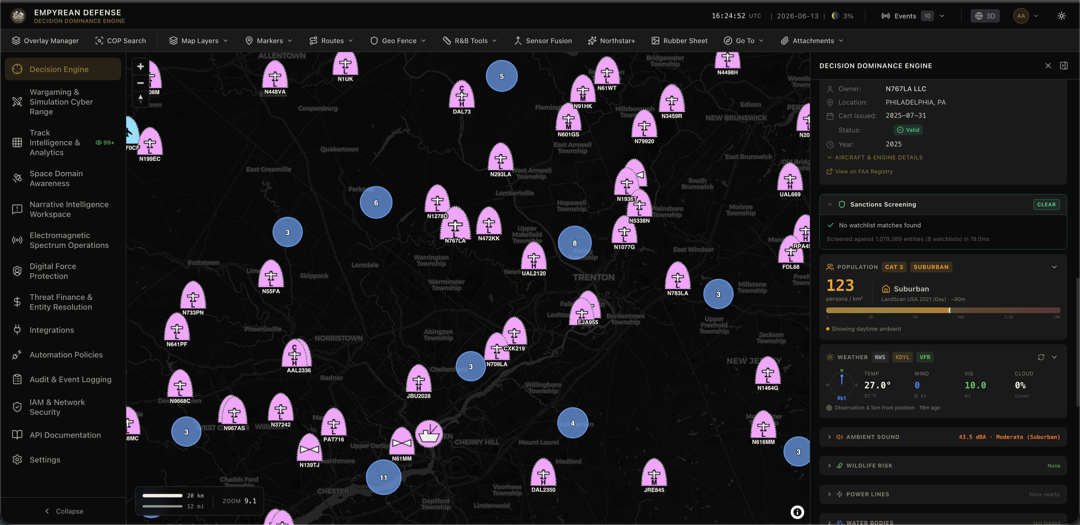
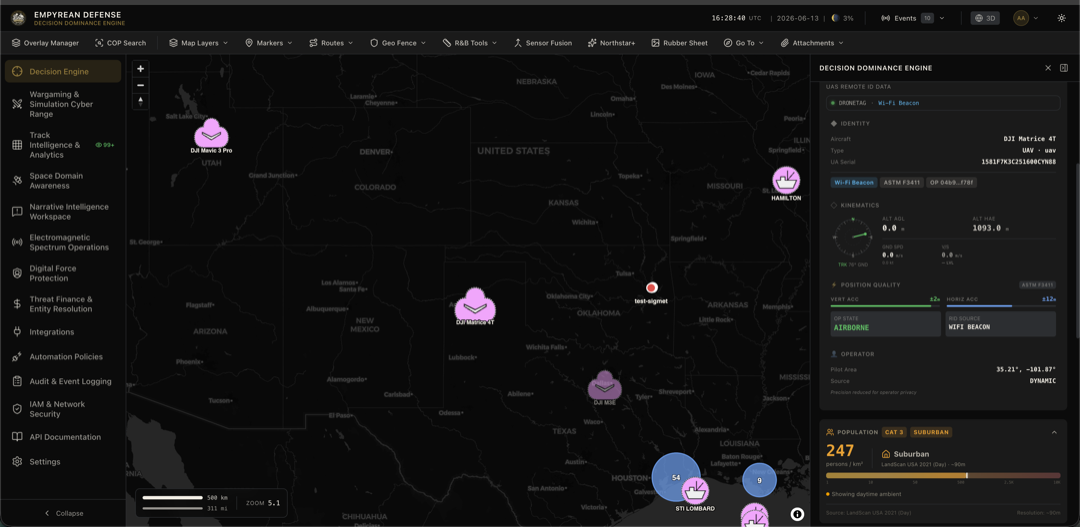
Empyrean's Air Domain Intelligence and UAS Traffic Management (UTM) eliminates the cognitive load of airspace management. Every aircraft track - manned or unmanned - is continuously assessed against the full aeronautical context: airspace classification, active restrictions, registered owner, transponder integrity, behavioral anomalies, and Remote ID authorization status. One actionable intelligence picture for the entire air domain.
The Problem
You're watching ADS-B tracks cross your screen. One of them just entered a Temporary Flight Restriction over a wildfire. Another is squawking 1200 at 400 feet in Class B airspace with no LAANC authorization. A third has been orbiting a critical infrastructure site for 45 minutes. Without context, a moving dot is just a moving dot. Your operators are manually cross-referencing FAA registries, checking NOTAM bulletins, computing airspace boundaries in their heads, and hoping they notice the anomaly before it matters. That takes 20-30 minutes per aircraft of interest. For a busy airspace with dozens of tracks, it's operationally impossible.
Who Has This Problem
Key Workflows
Capabilities
Platform Integration
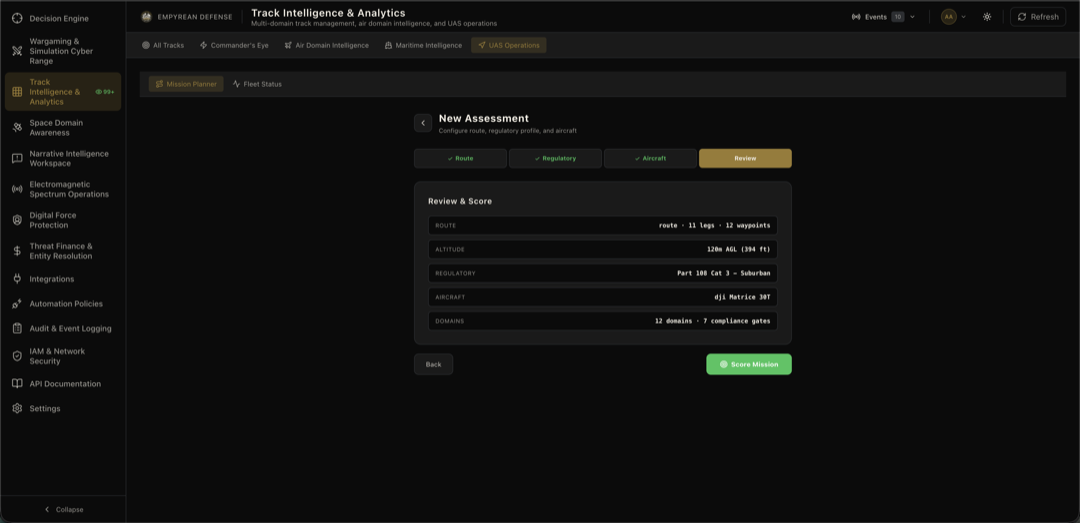
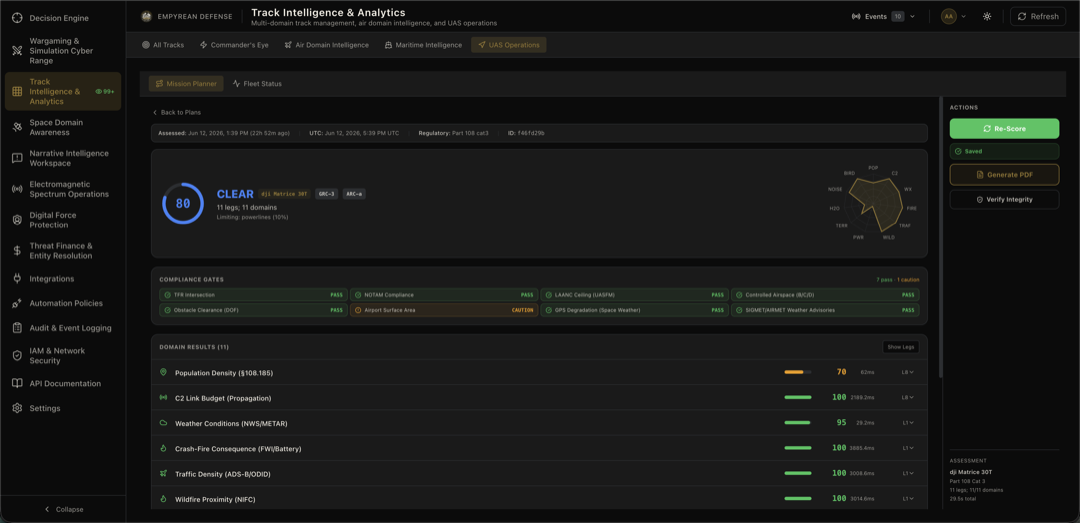
Air Domain Intelligence & UTM is built on the same platform architecture as every other Empyrean domain. Every aircraft track is automatically enriched - registration, regulatory history, sanctions screening, and live weather context - without manual queries. The platform is architected for Part 146 ADSP (Automated Data Service Provider) compliance, with Level 2 FAA engagement in progress. The Policy Engine evaluates compound conditions: an aircraft entering a TFR, a transponder degrading, weather minimums breached, or a drone operating without authorization all fire the same automated workflow architecture. Environmental data, weather observations, reference layers, and regulatory databases are stored locally - the platform functions identically in internet-connected, DDIL, and fully air-gapped environments. Aircraft owners are screened against the unified TFER screening engine (OFAC, EU, UK, UN, OpenSanctions - 500K+ entities). The same spatiotemporal data fabric that powers maritime route risk scoring drives the 21-dimension UAS Safety Risk Management assessment.
Air Domain Integrations — 7 connectors shipping today →Related Resources & Insights
What is Digital Force Protection?
Digital Force Protection explained: countering ubiquitous technical surveillance through device census, co-traveler analysis, signature management, and fused defensive measurement.
What is Intelligence Fusion?
Intelligence fusion explained: JDL/DFIG model, multi-INT disciplines, JADC2, and what fusion means for civilian operators.
What is Maritime Intelligence?
Maritime intelligence explained: AIS limits, dark vessels, beneficial ownership, sanctions risk, and multi-INT fusion at sea.
What is OPSEC?
OPSEC, UTS, and Digital Force Protection explained: the five-step process, five threat vectors, and signature management.
What is ATAK?
ATAK explained: TAK clients, EUDs, data packages, mesh networks, federation, plugins, and the CoT protocol that ties it together.
Defense & Intelligence Glossary
Defense & intelligence glossary: acronyms and terms for EMSO, C-UAS, JADC2, sensor fusion, SSA, CTF, entity resolution, and TAK.
What is Counter Threat Finance?
Counter Threat Finance (CTF) explained: DoDD 5205.14 doctrine, CTF vs. AML, sanctions, shell companies, TBML, and operational software.
What is Entity Resolution?
Entity Resolution explained: deterministic, probabilistic, ML, and graph methods for matching records to real-world identities.
What is Narrative Intelligence?
Narrative Intelligence (NARINT) explained: detecting and countering influence operations, DISARM framework, CIB, and OSINT.
What is EMSO?
EMSO explained: Electronic Warfare, EMBM, JEMSO, Electronic Order of Battle, CEMA, spectrum management, and operational software.
What is a Common Operational Picture?
Common Operational Picture (COP) explained: why most COPs fail, display vs. decision surface, edge deployment, and true fusion.
What is Space Situational Awareness?
Space Situational Awareness (SSA) explained: orbital tracking, TLEs, the Space Surveillance Network, and counterspace threats.
What is Counter-UAS?
Counter-UAS (C-UAS) explained: sensors, fusion, effectors, legal authorities, and layered drone defense for military and critical sites.
What is JADC2?
JADC2 explained: why top-down fails, what sensor-up architecture means, and why edge-deployed fusion survives contact.
What is Sensor Fusion?
Sensor fusion explained: state estimation, data association, multi-hypothesis tracking, identity provenance, and edge deployment.
High-Powered Microwave (HPM): From Hard Kill to Residual Risk
3,400 Monte Carlo runs reveal HPM's service-rate ceiling, residual warhead hazard, and cascade failure against 40-400 drone swarms.
The Devil Dog and the Dragon: USMC IADS vs. PLARF Cruise Missile Saturation
USMC MRIC vs 60 CJ-10 cruise missiles: 92.7% kill rate, then magazine exhaustion at T+28:37. The Marines need more rounds.
Quantifying Layered Naval Defense Against Hypersonic Glide Vehicles
DF-17 HGV vs Arleigh Burke: 50 Monte Carlo seeds, SM-6 at 23% kill rate, PAC-3 at zero. The timeline is the constraint.
Ubiquitous Technical Surveillance Will Get You Killed on the Streets
How commercial location data, advertising identifiers, co-travel analysis, and data fusion expose military personnel—and what digital force protection can do.
Maritime Domain Awareness: The Complete Field Guide
Maritime domain awareness field guide: spectrum, seabed, ownership, and cyber threats that single-domain tools miss.
TAK Server on AWS: From Zero to Operational in Under Ten Minutes
Deploy TAK Server on AWS with CloudFormation: TLS, Docker, hardening, and security best practices in under ten minutes.
Release Log Vol. 1: Maritime Intelligence & UAS Traffic Management
Empyrean ships Maritime Intelligence, Air Domain Intelligence, and UAS Traffic Management with 20+ data sources and FAA enrichment.
The Environment Is Trying to Kill Your Mission. We Want to Mitigate It.
Weather & environmental intelligence that modifies sensor confidence, route feasibility, and UAS BVLOS risk in real time.
EMSO Is Everyone's Problem. Let's Do Something About It.
EMSO deep dive: EW history, doctrinal evolution to CEMA, cross-domain effects, and what operators can do about it today.
Would the Real Common Operating Picture (COP) Please Stand Up
Most COPs are PowerPoint and uncorrelated feeds. What a real COP requires: fusion, policy, edge deployment, and echelon logic.
Building Physics-Backed, Unclassified, Open-Source Defense Research
Introducing Empyrean Defense Research: unclassified, physics-backed wargaming. First drop: 1,500 Monte Carlo sims of DF-17 vs DDG.
How the Space Domain Impacts Your Operations
Space domain impacts on EW, ground, maritime, air, and information ops — and what you can do to counter them.
Sense, Make Sense, Act: How to Conduct Counter-UAS From Sensors to Deployments
Counter-UAS playbook: 8 sensor types, fusion methods, jam vs. shoot decisions, and layered drone defense for DDIL environments.
Why JADC2 Needs Sensor Fusion at the Edge
JADC2 assumes persistent cloud and top-down authority. Operators have neither. Why sensor fusion must live at the edge.
What is Digital Force Protection?
Digital Force Protection explained: countering ubiquitous technical surveillance through device census, co-traveler analysis, signature management, and fused defensive measurement.
What is Intelligence Fusion?
Intelligence fusion explained: JDL/DFIG model, multi-INT disciplines, JADC2, and what fusion means for civilian operators.
What is Maritime Intelligence?
Maritime intelligence explained: AIS limits, dark vessels, beneficial ownership, sanctions risk, and multi-INT fusion at sea.
What is OPSEC?
OPSEC, UTS, and Digital Force Protection explained: the five-step process, five threat vectors, and signature management.
What is ATAK?
ATAK explained: TAK clients, EUDs, data packages, mesh networks, federation, plugins, and the CoT protocol that ties it together.
Defense & Intelligence Glossary
Defense & intelligence glossary: acronyms and terms for EMSO, C-UAS, JADC2, sensor fusion, SSA, CTF, entity resolution, and TAK.
What is Counter Threat Finance?
Counter Threat Finance (CTF) explained: DoDD 5205.14 doctrine, CTF vs. AML, sanctions, shell companies, TBML, and operational software.
What is Entity Resolution?
Entity Resolution explained: deterministic, probabilistic, ML, and graph methods for matching records to real-world identities.
What is Narrative Intelligence?
Narrative Intelligence (NARINT) explained: detecting and countering influence operations, DISARM framework, CIB, and OSINT.
What is EMSO?
EMSO explained: Electronic Warfare, EMBM, JEMSO, Electronic Order of Battle, CEMA, spectrum management, and operational software.
What is a Common Operational Picture?
Common Operational Picture (COP) explained: why most COPs fail, display vs. decision surface, edge deployment, and true fusion.
What is Space Situational Awareness?
Space Situational Awareness (SSA) explained: orbital tracking, TLEs, the Space Surveillance Network, and counterspace threats.
What is Counter-UAS?
Counter-UAS (C-UAS) explained: sensors, fusion, effectors, legal authorities, and layered drone defense for military and critical sites.
What is JADC2?
JADC2 explained: why top-down fails, what sensor-up architecture means, and why edge-deployed fusion survives contact.
What is Sensor Fusion?
Sensor fusion explained: state estimation, data association, multi-hypothesis tracking, identity provenance, and edge deployment.
High-Powered Microwave (HPM): From Hard Kill to Residual Risk
3,400 Monte Carlo runs reveal HPM's service-rate ceiling, residual warhead hazard, and cascade failure against 40-400 drone swarms.
The Devil Dog and the Dragon: USMC IADS vs. PLARF Cruise Missile Saturation
USMC MRIC vs 60 CJ-10 cruise missiles: 92.7% kill rate, then magazine exhaustion at T+28:37. The Marines need more rounds.
Quantifying Layered Naval Defense Against Hypersonic Glide Vehicles
DF-17 HGV vs Arleigh Burke: 50 Monte Carlo seeds, SM-6 at 23% kill rate, PAC-3 at zero. The timeline is the constraint.
Ubiquitous Technical Surveillance Will Get You Killed on the Streets
How commercial location data, advertising identifiers, co-travel analysis, and data fusion expose military personnel—and what digital force protection can do.
Maritime Domain Awareness: The Complete Field Guide
Maritime domain awareness field guide: spectrum, seabed, ownership, and cyber threats that single-domain tools miss.
TAK Server on AWS: From Zero to Operational in Under Ten Minutes
Deploy TAK Server on AWS with CloudFormation: TLS, Docker, hardening, and security best practices in under ten minutes.
Release Log Vol. 1: Maritime Intelligence & UAS Traffic Management
Empyrean ships Maritime Intelligence, Air Domain Intelligence, and UAS Traffic Management with 20+ data sources and FAA enrichment.
The Environment Is Trying to Kill Your Mission. We Want to Mitigate It.
Weather & environmental intelligence that modifies sensor confidence, route feasibility, and UAS BVLOS risk in real time.
EMSO Is Everyone's Problem. Let's Do Something About It.
EMSO deep dive: EW history, doctrinal evolution to CEMA, cross-domain effects, and what operators can do about it today.
Would the Real Common Operating Picture (COP) Please Stand Up
Most COPs are PowerPoint and uncorrelated feeds. What a real COP requires: fusion, policy, edge deployment, and echelon logic.
Building Physics-Backed, Unclassified, Open-Source Defense Research
Introducing Empyrean Defense Research: unclassified, physics-backed wargaming. First drop: 1,500 Monte Carlo sims of DF-17 vs DDG.
How the Space Domain Impacts Your Operations
Space domain impacts on EW, ground, maritime, air, and information ops — and what you can do to counter them.
Sense, Make Sense, Act: How to Conduct Counter-UAS From Sensors to Deployments
Counter-UAS playbook: 8 sensor types, fusion methods, jam vs. shoot decisions, and layered drone defense for DDIL environments.
Why JADC2 Needs Sensor Fusion at the Edge
JADC2 assumes persistent cloud and top-down authority. Operators have neither. Why sensor fusion must live at the edge.
What is Digital Force Protection?
Digital Force Protection explained: countering ubiquitous technical surveillance through device census, co-traveler analysis, signature management, and fused defensive measurement.
What is Intelligence Fusion?
Intelligence fusion explained: JDL/DFIG model, multi-INT disciplines, JADC2, and what fusion means for civilian operators.
What is Maritime Intelligence?
Maritime intelligence explained: AIS limits, dark vessels, beneficial ownership, sanctions risk, and multi-INT fusion at sea.
What is OPSEC?
OPSEC, UTS, and Digital Force Protection explained: the five-step process, five threat vectors, and signature management.
What is ATAK?
ATAK explained: TAK clients, EUDs, data packages, mesh networks, federation, plugins, and the CoT protocol that ties it together.
Defense & Intelligence Glossary
Defense & intelligence glossary: acronyms and terms for EMSO, C-UAS, JADC2, sensor fusion, SSA, CTF, entity resolution, and TAK.
What is Counter Threat Finance?
Counter Threat Finance (CTF) explained: DoDD 5205.14 doctrine, CTF vs. AML, sanctions, shell companies, TBML, and operational software.
What is Entity Resolution?
Entity Resolution explained: deterministic, probabilistic, ML, and graph methods for matching records to real-world identities.
What is Narrative Intelligence?
Narrative Intelligence (NARINT) explained: detecting and countering influence operations, DISARM framework, CIB, and OSINT.
What is EMSO?
EMSO explained: Electronic Warfare, EMBM, JEMSO, Electronic Order of Battle, CEMA, spectrum management, and operational software.
What is a Common Operational Picture?
Common Operational Picture (COP) explained: why most COPs fail, display vs. decision surface, edge deployment, and true fusion.
What is Space Situational Awareness?
Space Situational Awareness (SSA) explained: orbital tracking, TLEs, the Space Surveillance Network, and counterspace threats.
What is Counter-UAS?
Counter-UAS (C-UAS) explained: sensors, fusion, effectors, legal authorities, and layered drone defense for military and critical sites.
What is JADC2?
JADC2 explained: why top-down fails, what sensor-up architecture means, and why edge-deployed fusion survives contact.
What is Sensor Fusion?
Sensor fusion explained: state estimation, data association, multi-hypothesis tracking, identity provenance, and edge deployment.
High-Powered Microwave (HPM): From Hard Kill to Residual Risk
3,400 Monte Carlo runs reveal HPM's service-rate ceiling, residual warhead hazard, and cascade failure against 40-400 drone swarms.
The Devil Dog and the Dragon: USMC IADS vs. PLARF Cruise Missile Saturation
USMC MRIC vs 60 CJ-10 cruise missiles: 92.7% kill rate, then magazine exhaustion at T+28:37. The Marines need more rounds.
Quantifying Layered Naval Defense Against Hypersonic Glide Vehicles
DF-17 HGV vs Arleigh Burke: 50 Monte Carlo seeds, SM-6 at 23% kill rate, PAC-3 at zero. The timeline is the constraint.
Ubiquitous Technical Surveillance Will Get You Killed on the Streets
How commercial location data, advertising identifiers, co-travel analysis, and data fusion expose military personnel—and what digital force protection can do.
Maritime Domain Awareness: The Complete Field Guide
Maritime domain awareness field guide: spectrum, seabed, ownership, and cyber threats that single-domain tools miss.
TAK Server on AWS: From Zero to Operational in Under Ten Minutes
Deploy TAK Server on AWS with CloudFormation: TLS, Docker, hardening, and security best practices in under ten minutes.
Release Log Vol. 1: Maritime Intelligence & UAS Traffic Management
Empyrean ships Maritime Intelligence, Air Domain Intelligence, and UAS Traffic Management with 20+ data sources and FAA enrichment.
The Environment Is Trying to Kill Your Mission. We Want to Mitigate It.
Weather & environmental intelligence that modifies sensor confidence, route feasibility, and UAS BVLOS risk in real time.
EMSO Is Everyone's Problem. Let's Do Something About It.
EMSO deep dive: EW history, doctrinal evolution to CEMA, cross-domain effects, and what operators can do about it today.
Would the Real Common Operating Picture (COP) Please Stand Up
Most COPs are PowerPoint and uncorrelated feeds. What a real COP requires: fusion, policy, edge deployment, and echelon logic.
Building Physics-Backed, Unclassified, Open-Source Defense Research
Introducing Empyrean Defense Research: unclassified, physics-backed wargaming. First drop: 1,500 Monte Carlo sims of DF-17 vs DDG.
How the Space Domain Impacts Your Operations
Space domain impacts on EW, ground, maritime, air, and information ops — and what you can do to counter them.
Sense, Make Sense, Act: How to Conduct Counter-UAS From Sensors to Deployments
Counter-UAS playbook: 8 sensor types, fusion methods, jam vs. shoot decisions, and layered drone defense for DDIL environments.
Why JADC2 Needs Sensor Fusion at the Edge
JADC2 assumes persistent cloud and top-down authority. Operators have neither. Why sensor fusion must live at the edge.
See Air Domain Intelligence & UTM in action
Schedule a walkthrough to see this capability in action.